Technical article. Written for readers who want the building science. Prefer the short version? Browse the Homeowner Guides.

Key takeaways
- Where attic insulation is missing, thin, compressed or displaced, heat from a 150°F+ attic enters the room below faster, and that room drifts above the thermostat set point.
- Sources: low or settled depth, gaps around lights, fans and hatches, compression under storage, unsealed ceiling penetrations, wind washing at the eaves and poorly insulated knee walls.
- Insulation depth mapped across the attic, thermal imaging during peak afternoon heat and blower door testing confirm where the ceiling is gaining heat.
- A larger HVAC unit does not remove the load. Air seal the ceiling plane before adding insulation, keep soffit vents open with baffles and get the ducts under the insulation first.
In many Desert Southwest homes, occupants notice that some rooms are consistently hotter or colder than others. One room may be several degrees warmer than the thermostat set point while another room feels comfortable. These room-to-room temperature differences are rarely “normal.” They are typically caused by measurable problems in the duct system, attic thermal conditions, or pressure relationships inside the home.
When the HVAC system delivers the correct supply air temperature but a specific room experiences excessive heat gain through the ceiling or knee walls, that room will drift above the thermostat set point. In the Southwest, the attic is often the dominant heat source, especially in the afternoon, so attic insulation quality can directly determine which rooms become “hot rooms.”
Cause: Insufficient Attic Insulation
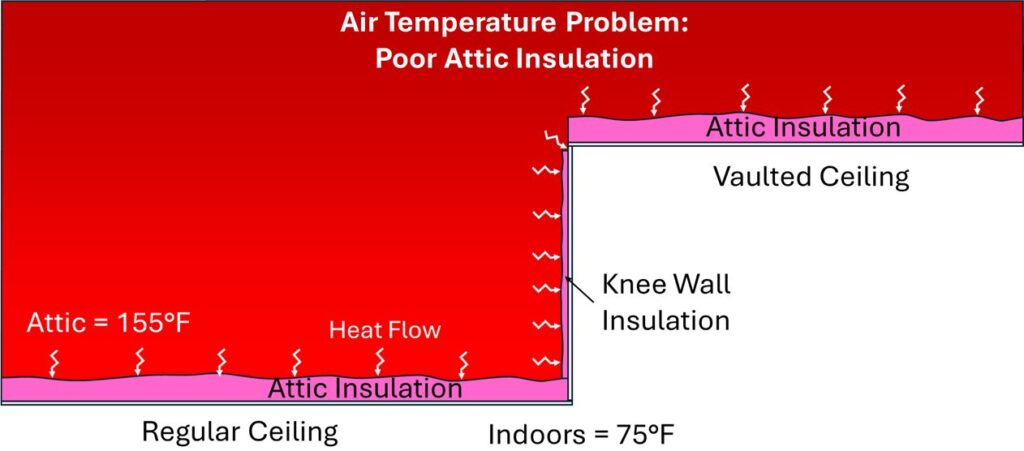
A common cause of hot and cold rooms is insufficient attic insulation over all or part of the home. The ceiling plane (and any knee walls behind vaulted ceilings) is the primary thermal boundary between conditioned living space and the attic. When insulation is missing, thin, compressed, displaced, or poorly installed, heat from a 150°F+ attic transfers into the room below.
This problem often affects only certain rooms because attic insulation is rarely uniform. Bedrooms at the perimeter, rooms under vaulted ceilings, rooms below attic storage areas, and rooms near attic access points frequently have lower effective R‑value than the rest of the house. The result is a predictable pattern: a few rooms run hot while the part of the home near the thermostat location remains acceptable.
Why Does Insufficient Attic Insulation Create Hot Rooms?
Heat transfer through the ceiling can be approximated using a basic building-science relationship: Q ≈ (A × ΔT) ÷ R, where A is the ceiling area, ΔT is the attic-to-room temperature difference, and R is the effective R-value of the insulation.¹
For example, consider a 200 ft² bedroom ceiling with an attic temperature of 150°F and an indoor set point of 75°F (ΔT = 75°F). With R-19 insulation, the ceiling heat gain is roughly (200 × 75) ÷ 19 ≈ 790 BTU/hr. With R-38, that drops to about 395 BTU/hr, approximately half. Multiply this by multiple rooms and multiple ceiling assemblies (flat ceilings + knee walls), and the impact becomes large enough to create multi-degree room temperature differences.
Insulation performance is also reduced by air movement. Wind washing at the eaves, convective looping in open cavities, and air leakage through ceiling penetrations can reduce the effective R‑value well below what the insulation label suggests. This is why attic insulation should be evaluated as part of a complete attic-and-duct performance system: system & room air flow + duct air sealing + duct insulation + attic air sealing + attic insulation depth, rather than “adding insulation” in isolation.
What Are the Sources of Insufficient Attic Insulation?
Attic insulation problems are usually caused by a combination of a low installed R-value, insulation defects, and long-term disturbance.
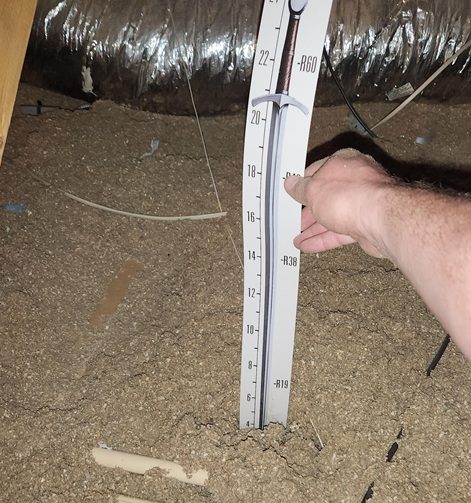
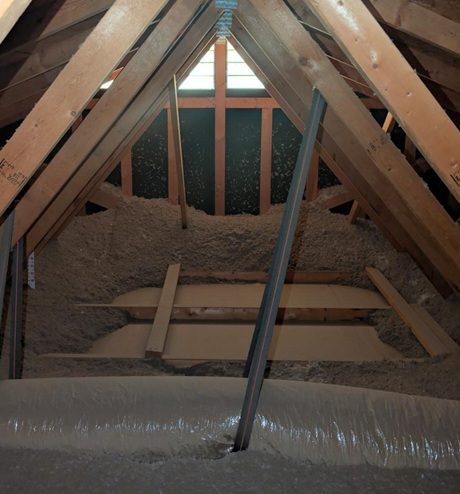
Insufficient Depth or Settling. Many homes were built with lower insulation levels than current code requirements. Over time, loose-fill insulation can settle, reducing depth and R‑value.³
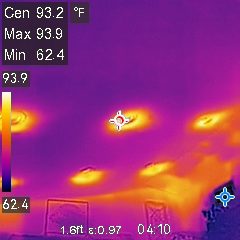
Gaps, Voids, and Displaced Insulation. Insulation is often missing around recessed lights, exhaust fans, plumbing/electrical penetrations, attic platforms, and attic access points. Even small voids act as thermal “bypasses” that dominate heat flow through that section of ceiling.
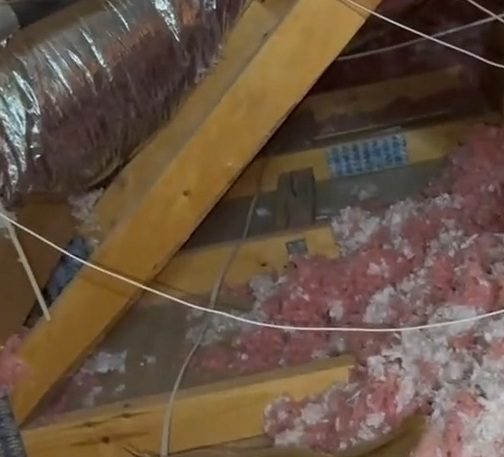
Compression from Storage or Foot Traffic. Insulation only delivers rated R‑value at its designed thickness. Compression reduces trapped air pockets and lowers performance.3
Missing Air Barrier. Insulation works best when combined with an air barrier. Ceiling penetrations (recessed lights, exhaust fans, plumbing vents, electrical boxes) that aren’t air-sealed allow hot attic air to bypass the insulation entirely through convection. The insulation slows conductive heat transfer, but convective airflow through gaps can transfer heat much faster. Air sealing and insulation work together, one without the other delivers incomplete protection.⁴
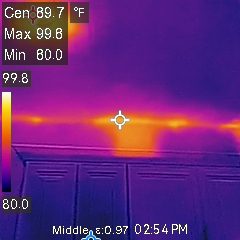
Wind Washing at Eaves. Soffit ventilation air can move through or across insulation at the attic edges. Without proper baffles, the insulation near exterior walls can underperform even if the center of the attic looks adequate.
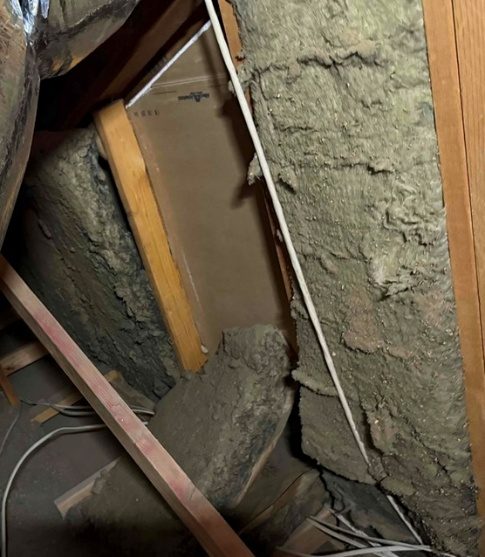
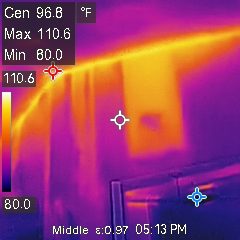
Poor Knee Wall Insulation and Air Barrier. In rooms with vaulted ceilings, knee walls and sloped ceilings create additional attic-facing surfaces. Fiberglass batts installed without a continuous air barrier behind them often allow attic air to flow through the insulation, reducing effectiveness and causing localized hot spots.4
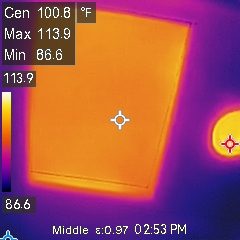
Uninsulated or Unsealed Attic Hatch. An attic hatch can act like a large thermal and air-leak opening during peak heat if it lacks insulation and gasket sealing.
Additional Effects of Insufficient Attic Insulation
Hot and cold rooms are often the most visible symptom, but insufficient attic insulation creates broader system impacts.
Radiant Discomfort. Even when air temperature is near set point, a hot ceiling increases mean radiant temperature and makes the room feel warmer than the thermostat indicates.
Longer Runtime and Higher Energy Use. The HVAC system must offset additional ceiling and knee wall heat gain before it can reduce room temperature. This increases equipment runtime and energy consumption. When the HVAC system eventually shuts off, the room with a lack of insulation will gain heat much quicker. Now the HVAC system must turn on more frequently to combat the rapid temperature increase.
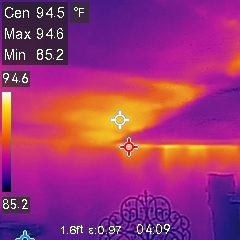
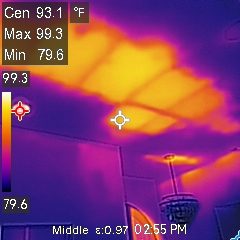
Worse Afternoon Performance. As attic temperature rises through the afternoon, ceiling heat gain increases. Many homes feel acceptable in the morning but become uncomfortable later in the day, an insulation signature that is measurable with thermal imaging.
Common Signs of Insufficient Attic Insulation
Attic insulation problems usually present with repeatable patterns:
- One or more rooms under the attic are consistently hotter than the rest of the home (especially in the afternoon).
- Vaulted-ceiling rooms or rooms adjacent to knee walls run warmer than other rooms.
- The ceiling surface feels warm to the touch during peak summer heat.
- Comfort improves noticeably after sunset as attic temperatures fall.
- Thermal imaging shows hot bands or hot patches on the interior ceiling.
For a plain-language overview of this condition, read the homeowner guide: Some Rooms Have a Heat Lamp in the Ceiling: You Just Can’t See It.
How Professionals Confirm This Condition
Professionals confirm insulation deficiencies through inspection and measurement, not guesswork.
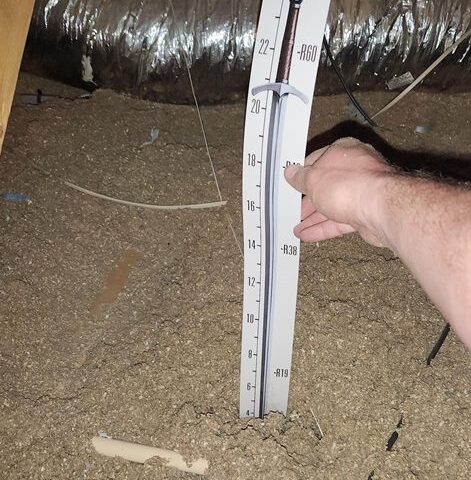
Attic Inspection and Depth Mapping. Measure insulation depth at multiple locations and convert depth to approximate R‑value based on insulation type. Document thin areas, gaps, and compression zones.
Thermal Imaging. Thermal imaging during peak afternoon conditions identifies ceiling hot spots that correlate with insulation voids, compression, or wind washing. This is especially valuable when insulation defects are not obvious from attic access points.
Air Leakage Diagnostics. Blower door testing (often paired with thermal imaging or smoke) identifies ceiling penetrations that allow hot attic air to bypass insulation. Air sealing and insulation work together; improving one without the other often leaves performance on the table.
KOTA Approach. Knights of the Attic commonly pairs attic air sealing (Insulated Attic Armor™) with upgraded blown-in insulation depth. The work is designed from those measurements, and the results are guaranteed in writing.5
What NOT to Do
These common “fixes” often waste money or create new problems:
- Do not assume a larger HVAC unit will fix the problem. If hot rooms are caused by excessive ceiling or knee wall heat gain, the load remains and comfort may still be uneven.
- Do not add insulation without addressing major air leaks at the ceiling plane. Convective heat gain from air leakage dramatically reduces insulation performance.
- Do not block soffit vents with insulation. Use baffles to maintain ventilation while achieving full insulation depth at the eaves.
- Do not compress existing insulation to “make room” for more. Compression reduces insulation R‑value.
- Do not ignore knee walls, attic hatches, or attic platforms. These are common hot-room drivers.
- Do not insulate your attic without getting your ducts under the insulation first. Ducts almost always have insufficient insulation. Drop your ducts first (and encapsulate them), then blow in new attic insulation over the top of both the ducts and your ceiling.6
References
- 1 DOE Building America Solutions Center. Blown Insulation for Existing Vented Attic: https://basc.pnnl.gov/resource-guides/blown-insulation-existing-vented-attic
- 2 ENERGY STAR. Recommended Home Insulation R‑Values (guidance for insulation upgrades): https://www.energystar.gov/saveathome/seal_insulate/identify-problems-you-want-fix/diy-checks-inspections/insulation-r-values
- 3 Building Science Corporation. BSI-043 “Don’t Be Dense” (air barriers + insulation interaction): https://buildingscience.com/documents/insights/bsi-043-dont-be-dense
- 4 DOE Building America Solutions Center. Attic Knee Walls: https://basc.pnnl.gov/resource-guides/attic-knee-walls
- 5 Knights of the Attic. Insulation Services (Insulated Attic Armor™ air sealing, blown-in insulation and knee wall insulation): https://knightsoftheattic.com/insulation/
- 6 DOE Building America Solutions Center. Ducts Buried in Attic Insulation and Encapsulated: https://basc.pnnl.gov/resource-guides/ducts-buried-attic-insulation-and-encapsulated
Solution: Click here to learn about solutions to this problem.