Technical article. Written for readers who want the building science. Prefer the short version? Browse the Homeowner Guides.
Key takeaways
- With R-19 in the attic, a 2,000 square foot ceiling lets roughly 8,000 to 9,000 BTU per hour into the home at peak, about 0.7 to 0.8 tons the system must overcome before it can cool. R-38 roughly halves that.
- The shortfall comes from too little depth, insulation compressed by platforms and foot traffic, gaps and voids, wind washing at the eaves, failed knee walls, and unsealed ceiling penetrations.
- A hot ceiling adds radiant discomfort, so rooms feel warm even at the set temperature, and the rooms under the attic run warmer than the rest of the house.
- Depth measurements, thermal imaging in the afternoon and a blower door test confirm it. Insulation without air sealing, compressed insulation and blocked soffit vents all fall short.
Summertime temperatures are extreme in the Desert Southwest. The HVAC systems in many homes are unable to maintain the temperature at the thermostat set point during the afternoon heat. This leads to comfort problems inside the home. If the HVAC system continues to struggle to recover after the sun goes down, the comfort problems are amplified because it becomes difficult for home occupants to sleep.
Cause: Insufficient Attic Insulation
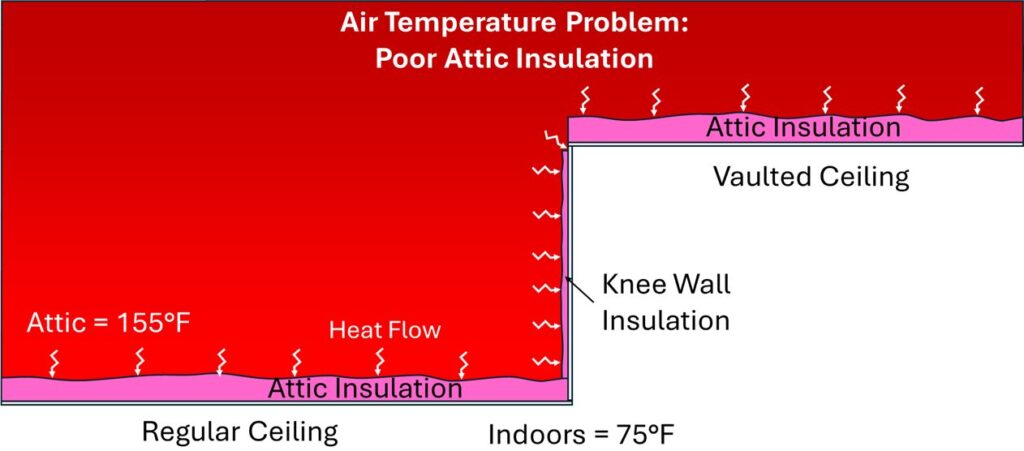
One cause of this problem is insufficient attic insulation. The ceiling plane is the primary thermal boundary between conditioned living space and the attic. When attic insulation is inadequate, missing, compressed, or poorly installed, heat from the superheated attic transfers directly into the home through the ceiling, adding cooling load that the HVAC system must overcome. In the Southwest, where attic temperatures routinely reach 150°F to 160°F during summer, the ceiling represents a massive potential heat gain pathway.
Why Does Insufficient Attic Insulation Reduce Cooling Capacity?
The ceiling plane separates conditioned space (75°F target) from attic space (150 to 160°F during Southwestern summer afternoons). This 75 to 85°F temperature difference drives heat flow through the ceiling. The rate of heat transfer depends on the ceiling area and the thermal resistance (R-value) of the insulation.¹
Many older Southwestern homes have R-19 attic insulation, the minimum code requirement when they were built. Current energy codes typically require R-38 to R-49 depending on climate zone. The difference in performance is substantial and directly measurable.
Using the simple steady-state conduction relationship (Q ≈ [A × ΔT] / R), a 2,000 ft² ceiling, an 80°F temperature difference (150°F attic to 70 to 75°F conditioned space), and effective R-19 insulation yields roughly 8,000 to 9,000 BTU/hr of conductive heat gain at peak conditions.
If the insulation is compressed, missing, wind-washed, or the ceiling plane is leaky, the *effective* performance is lower and the total heat gain can be significantly higher.
Even at ~8,000 to 9,000 BTU/hr, that’s roughly 0.7 to 0.8 tons of cooling load that the equipment must overcome before it can begin pulling indoor temperatures down.
Upgrading to R-38 roughly halves this conductive heat gain. Upgrading to R-49 or higher reduces it further. The improvement directly increases the effective cooling capacity available to maintain comfort.
What Are the Sources of Insufficient Attic Insulation?
Inadequate attic insulation results from several conditions.
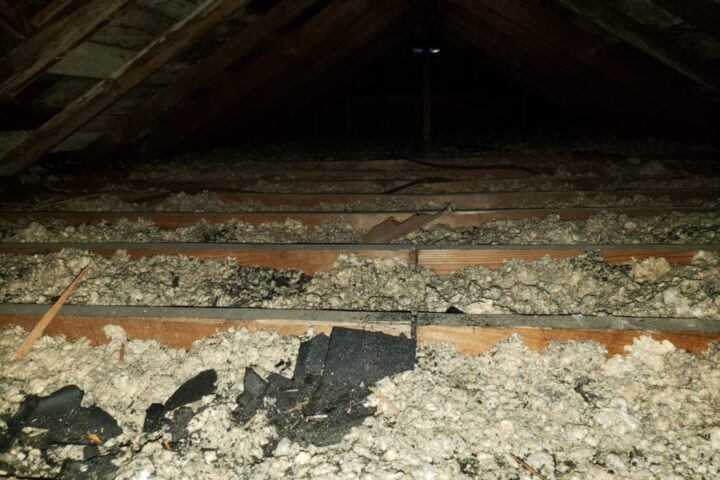
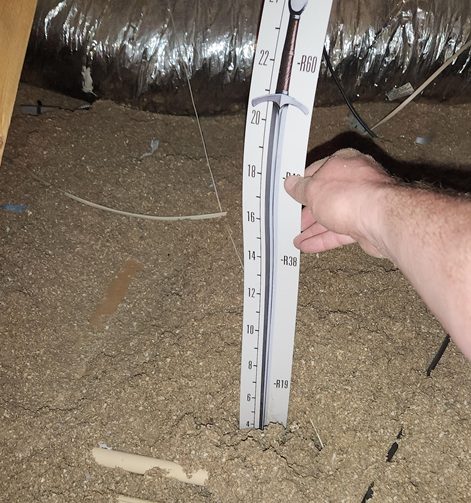
Insufficient Depth. Many homes simply don’t have enough insulation. R-19 requires approximately 6 to 7 inches of fiberglass batts or 5 to 6 inches of blown insulation. R-38 requires roughly double those depths. Homes built to older codes, or where insulation has settled over time, often fall short of modern performance standards.²
Compression and Displacement. Insulation that has been compressed by storage items, HVAC equipment platforms, or foot traffic loses R-value. The R-value of insulation depends on trapped air pockets; compression eliminates these air pockets. Compressed insulation may look like it covers the ceiling but performs far below its rated value.
Storage platforms, walkways, and equipment supports installed on top of insulation compress the material underneath. Areas around HVAC equipment in attics are frequently under-insulated because the insulation was displaced during installation or maintenance.
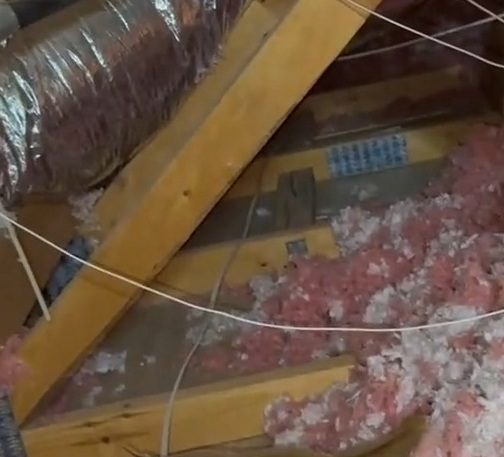
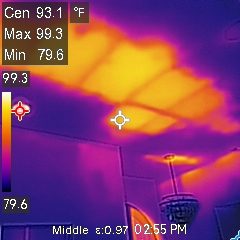
Gaps and Voids. Insulation that doesn’t cover the entire ceiling plane creates thermal bypass paths. Heat flows through the path of least resistance. A gap in insulation allows heat to pour through even if surrounding areas are well-insulated. Common gap locations include areas around HVAC equipment, at attic hatches, at ceiling transitions (tray ceilings, soffits), around plumbing and electrical penetrations, and at the junction between ceiling and exterior walls.³
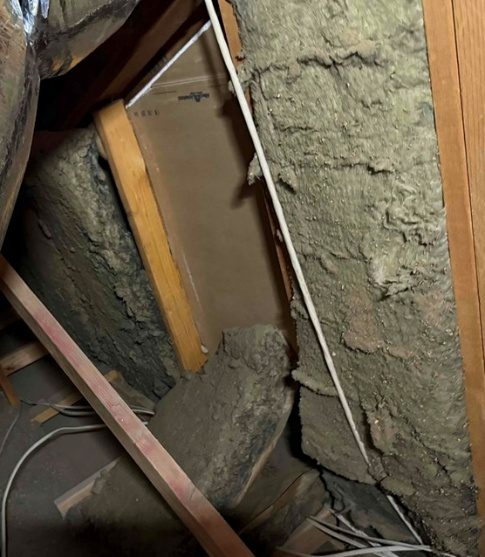
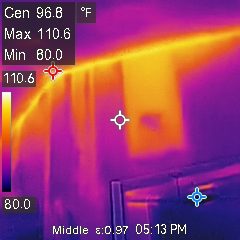
Wind Washing. At eaves and where the attic meets soffit vents, wind can move through loose-fill insulation, reducing its effective R-value. As air moves through the insulation, it carries heat directly into the material, bypassing the insulation’s resistance. Without proper baffles to prevent wind washing, the edges of the insulation layer may perform poorly even when adequate depth is present in the center of the attic.
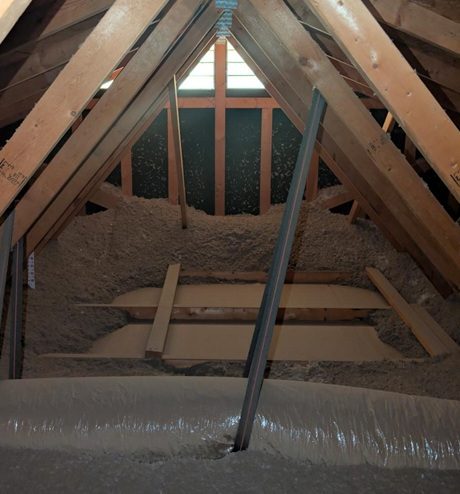
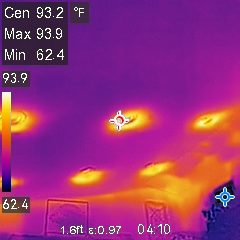
Missing Air Barrier. Insulation works best when combined with an air barrier. Ceiling penetrations (recessed lights, exhaust fans, plumbing vents, electrical boxes) that aren’t air-sealed allow hot attic air to bypass the insulation entirely through convection. The insulation slows conductive heat transfer, but convective airflow through gaps can transfer heat much faster. Air sealing and insulation work together. One without the other delivers incomplete protection.⁴
Additional Effects of Insufficient Attic Insulation
Beyond adding cooling load, inadequate attic insulation creates secondary problems.
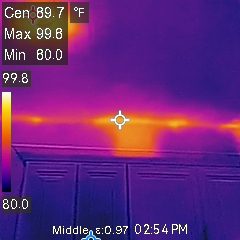
Ceiling heat gain doesn’t just add load. It creates radiant discomfort. Even when air temperature is acceptable, occupants may feel uncomfortably warm because the ceiling surface is radiating heat downward. This radiant effect is why homes with poor attic insulation often feel uncomfortable even when the thermostat shows the desired temperature. The mean radiant temperature of a room affects comfort as much as air temperature.
The load from ceiling heat gain varies with time of day and attic temperature. Systems may maintain temperature adequately in the morning but fall behind in the afternoon as attic temperatures peak. The common complaint that the house “heats up” in the afternoon often traces directly to ceiling heat gain.
Because ceiling heat gain affects rooms differently based on their exposure (rooms under the attic versus rooms over a garage or slab), it contributes to hot and cold room complaints. Second-floor rooms and single-story rooms under poorly insulated attic areas are consistently warmer than rooms with other exposures.
The additional runtime required to overcome ceiling heat gain increases energy consumption proportionally. In the Southwest, where cooling systems run extensively during summer months, inadequate attic insulation can add hundreds of dollars per year to cooling costs.
Common Signs of Insufficient Attic Insulation
Homeowners typically notice several indicators of ceiling heat gain problems:
- The home feels warmer in the afternoon even when the thermostat setting hasn’t changed.
- Upper floors (if applicable) are consistently warmer than lower floors.
- Rooms under the attic feel warmer than rooms over conditioned spaces (garages, etc.).
- The ceiling feels warm to the touch during hot afternoons.
- Temperature in the home tracks with outdoor temperature even when the system runs constantly.
- Thermal discomfort even when the thermostat shows the target temperature.
For a plain-language overview of this condition, read the homeowner guide: Your Ceiling Is a Hot Plate, and Your AC Is Fighting a Losing Battle.
How Professionals Confirm This Condition
Professionals confirm attic insulation problems through inspection and measurement.
Visual Inspection. Visual inspection of attic insulation identifies depth, type, condition, gaps, and compression. Insulation depth can be measured and converted to approximate R-value based on material type. Visible gaps, disturbed areas, and compression indicate problem zones.
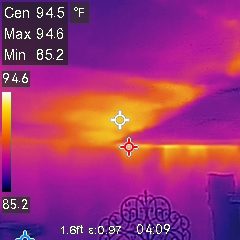
Thermal Imaging. Thermal imaging during afternoon conditions reveals ceiling heat patterns from inside the home. Areas of inadequate insulation appear as hot spots on interior ceiling surfaces. Thermal imaging can identify gaps, thin spots, and compression that may not be visible from the attic side due to limited access or blown-in insulation covering the problem areas.
R-Value Assessment. Measure insulation depth in multiple locations and estimate approximate R-value based on material type (values vary by product). Typical ranges: fiberglass batts ~3.0 to 3.7 per inch; blown fiberglass ~2.2 to 2.8 per inch; blown cellulose ~3.2 to 3.8 per inch. Compare results to code targets (often R-38 to R-49) to quantify improvement opportunity.
Air Leakage Testing. Blower door testing with thermal imaging identifies ceiling penetrations that allow air bypass. Even if insulation depth is adequate, unsealed penetrations can significantly reduce effective performance.
At Knights of the Attic, we use each of these techniques to diagnose attic insulation deficiencies and design the corrective work around what they show.
What NOT to Do
Certain responses to attic insulation problems are ineffective or counterproductive.
- Do not assume adding insulation alone will solve the problem if there are significant air leaks. Air sealing should accompany insulation improvements for maximum effectiveness. Adding insulation over unsealed penetrations provides limited benefit because convective heat transfer continues through the gaps.
- Do not forget knee walls. Attic knee walls are often at greatest risk of poor thermal performance because of the vertical surfaces. Gravity is working to pull insulation away from knee walls vs. holding it in place on ceilings. Plus, vertical surfaces with imperfect insulation contact encourage thermal convection loops, transferring even more heat from the attic through the knee wall into the home.5
- Do not compress insulation when adding more. Insulation must maintain its design thickness to provide a rated R-value. Packing more insulation into limited space does not increase R-value proportionally. It may actually decrease it by eliminating the air pockets that provide thermal resistance.
- Do not block soffit vents when adding insulation at eaves. Attic ventilation is important for reducing peak attic temperatures and managing moisture. Install baffles to maintain airflow while allowing full insulation depth at the eaves.
- Do not ignore the attic hatch or access panel. This is often the weakest point in ceiling insulation. An uninsulated, unsealed attic hatch can transfer as much heat as the ceiling in an entire room.
References
- ¹ DOE Building America Solutions Center. Blown Insulation for Existing Vented Attic: https://basc.pnnl.gov/resource-guides/blown-insulation-existing-vented-attic
- ² Energy Star. Recommended Home Insulation R-Values by Climate Zone: https://www.energystar.gov/saveathome/seal_insulate/identify-problems-you-want-fix/diy-checks-inspections/insulation-r-values
- ³ Building Science Corporation. BSI-043: Don’t Be Dense (Insulation and Air Barriers): https://buildingscience.com/documents/insights/bsi-043-dont-be-dense
- ⁴ DOE Building America Solutions Center. Air Sealing and Insulating Ceilings in Vented Attics: https://basc.pnnl.gov/resource-guides/air-sealing-and-insulating-ceilings-vented-attics
- 5 DOE Building America Solutions Center. Attic Knee Walls: https://basc.pnnl.gov/resource-guides/attic-knee-walls
Solution: Click here to learn about solutions to this problem.