Technical article. Written for readers who want the building science. Prefer the short version? Browse the Homeowner Guides.

Key takeaways
- A vented attic needs low intake at the soffits and high exhaust at the ridge or roof. When either is short or blocked, attic temperature climbs higher and stays high longer.
- The hotter attic raises duct heat gain, ceiling heat gain and knee wall heat gain, so the system spends its capacity on attic heat through the late afternoon and early evening.
- The usual causes are too little net free vent area, soffit vents buried in insulation, exhaust without matching intake, and blocked rafter bays.
- A powered attic fan is not a shortcut. With a leaky ceiling it pulls conditioned air out of the home, so seal the ceiling plane first and pair ventilation with duct insulation.
Summertime temperatures are extreme in the Desert Southwest. The HVAC systems in many homes are unable to maintain the temperature at the thermostat set point during the afternoon heat. This leads to comfort problems inside the home. If the HVAC system continues to struggle to recover after the sun goes down, the comfort problems are amplified because it becomes difficult for home occupants to sleep.
Cause: Insufficient Attic Ventilation
One cause of this problem is insufficient attic ventilation. In a vented attic, outside air enters through low vents (typically soffit/eave) and exits through high vents (ridge, gable, or roof vents). The goal is to remove super-heated attic air and reduce heat build-up under the roof deck. When the ventilation area is inadequate, vents are blocked, or intake/exhaust is unbalanced; attic temperatures climb higher and stay high longer. In the Phoenix area, attic air can exceed 150°F on summer afternoons, which turns the attic into a heat source that works against your HVAC system.
Insufficient ventilation does not only affect attic air temperature. High attic temperatures increase duct heat gain, ceiling heat gain, and knee wall heat gain. These loads reduce the HVAC system’s ability to “keep up” during peak conditions, even if the equipment itself is functioning correctly.
Why Does Insufficient Attic Ventilation Reduce Cooling Capacity?
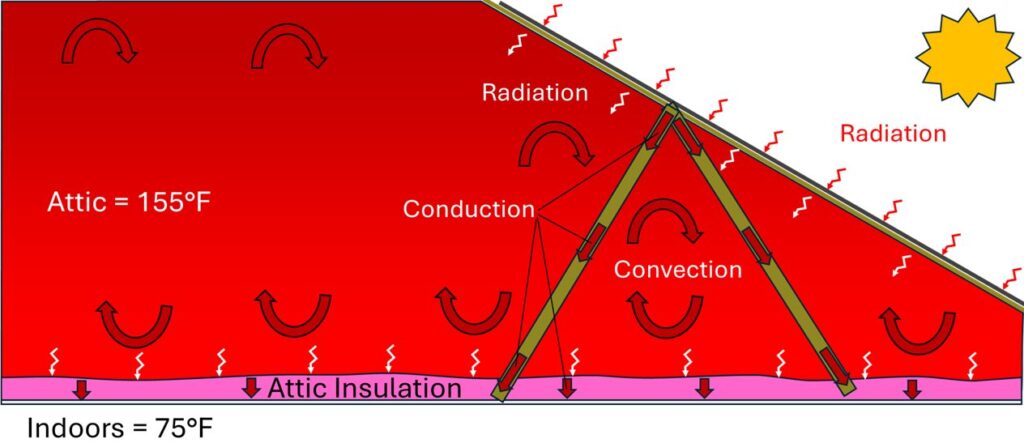
During the summer, solar radiation heats the roof, which heats the attic air and the materials inside the attic (ducts, insulation, framing). When attic ventilation is inadequate, the attic air temperature rises and the roof deck and attic contents stay hotter. This increases heat transfer into the living space by conduction (through the ceiling/insulation) and by duct heat gain (as supply air travels through hot attic ducts).¹
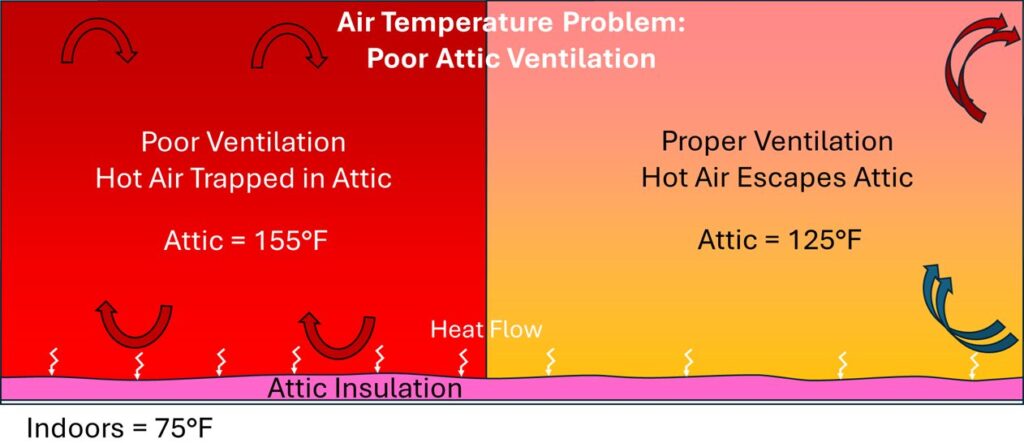
Because cooling capacity is limited, the HVAC system has to spend a portion of its output offsetting attic-driven heat gain before it can reduce indoor air temperature. The impact is most noticeable in the afternoon and early evening, when attic temperatures are highest and the home is receiving the greatest solar load.
What Are the Sources of Insufficient Attic Ventilation?
Most attic ventilation problems are caused by a combination of inadequate vent area and restricted airflow paths.
Insufficient Net Free Vent Area (NFVA). Building codes typically require a minimum amount of attic ventilation area, often expressed as a ratio (e.g., 1/300 of attic floor area under certain conditions). If the total NFVA is below requirement, or if intake/exhaust distribution is poor, the attic cannot flush heat effectively.²
Blocked or Missing Soffit Intake. Soffit vents are commonly blocked by insulation, debris, or poorly installed baffles. Without adequate intake, high vents cannot exhaust effectively. ENERGY STAR specifically cautions against covering soffit vents with insulation and recommends using baffles to maintain airflow.³
Unbalanced Ventilation (All Exhaust, No Intake, or Vice Versa). A ridge vent with minimal soffit intake (or gable vents without low intake) can short-circuit airflow and reduce overall attic flushing. Balanced high/low ventilation is preferred for predictable flow paths.1
Restricted Air Channels in Each Rafter Bay. In many attics, insulation or framing blocks air pathways from soffit to ridge. Even if vents exist, air must be able to travel through the rafter bays or attic space to provide meaningful flushing.1
Mechanical Attic Fans Used Without Air Sealing. Powered attic fans can exhaust heat, but if the ceiling plane is leaky, the fan may pull conditioned air from the living space into the attic, making the HVAC system work harder. ENERGY STAR notes that attic fans without air sealing can use more energy than alternative methods and may draw conditioned air if the attic floor is leaky.1
Additional Effects of Insufficient Attic Ventilation
High attic temperatures accelerate duct and insulation degradation. Elevated temperatures can soften duct sealants, stress duct jackets, and shorten the service life of attic materials. Poor ventilation can also increase duct heat gain and ceiling heat gain, creating hot rooms and increasing utility bills. In some cases, excessive attic temperatures contribute to duct system failures over time (sealant failure, connection failure, and component deterioration).
Common Signs of Insufficient Attic Ventilation
Homeowners typically notice several indicators when attic ventilation is inadequate:
- Cooling performance is acceptable in the morning, but the home falls behind in late afternoon and early evening
- Supply air at distant registers feels warmer during peak heat (duct heat gain increases as attic gets hotter)
- Rooms directly under the attic ceiling are warmer than rooms over conditioned space
- Attic feels excessively hot even compared to outdoor temperature; insulation and ducts feel hot to the touch
- Roof decking or attic framing feels unusually hot during peak sun hours
For a plain-language overview of this condition, read the homeowner guide: Your Attic Is Trapping Heat Like a Greenhouse, and Your AC Pays the Price.
How Professionals Confirm This Condition
Professionals confirm ventilation problems through inspection and measurement.
Ventilation Calculation. Determine existing net free vent area (NFVA) and compare to code or design guidance (e.g., 1/300 with balanced high/low vents under typical conditions).²
Physical Inspection. Inspect soffit vents, ridge vents, gable vents, and roof vents for blockage, missing baffles, or short-circuiting airflow paths.
Temperature Mapping. Measure attic air temperature at multiple locations during peak sun and compare to outdoor conditions. Thermal imaging can identify overheated duct runs and ceiling hot spots.
Duct Temperature Checks. Measure supply air temperature at the equipment and at distant registers during peak attic heat to quantify duct heat gain.
At Knights of the Attic (KnightsOfTheAttic.com), attic ventilation is evaluated as part of the complete attic-and-duct thermal system. We use thermal imaging and temperature mapping to identify heat gain pathways, then design corrective measures that may include combining an attic ventilation fan with attic air seal, restoring balanced passive ventilation, improving baffles and airflow channels, and combining ventilation improvements with duct thermal protection (e.g., Insulated Duct Armor™ and duct burial/wrap) and attic thermal upgrades. Our approach is to measure, design, improve, and guarantee the result.⁵
What NOT to Do
Avoid these common mistakes when trying to address attic heat and ventilation issues:
- Do not cover soffit vents with insulation. This blocks intake air and worsens attic heat build-up.
- Do not rely on a powered attic fan without first addressing attic-plane air leakage. Fans can pull conditioned air from the home if the ceiling plane is not properly sealed first.
- Do not assume ventilation alone will solve duct heat gain if ducts are uninsulated or poorly insulated. Both attic ventilation and duct insulation work together to minimize excessive heat gain.
- Do not ignore bathroom/kitchen exhaust fans that terminate into the attic. Exhaust must terminate outdoors to prevent moisture and heat issues.4
References
- ¹ DOE Building America Solutions Center. Attic Ventilation Fans: https://basc.pnnl.gov/information/attic-ventilation-fans
- ² DOE Building America Solutions Center. Calculating Attic Passive Ventilation (NFVA and distribution): https://basc.pnnl.gov/information/calculating-attic-passive-ventilation
- ³ ENERGY STAR. About Attic Ventilation: https://www.energystar.gov/saveathome/seal_insulate/do-it-yourself-guide/about-attic-ventilation
- ⁴ DOE Building America Solutions Center. Bathroom Exhaust Fans https://basc.pnnl.gov/resource-guides/bathroom-exhaust-fans
- ⁵ Knights of the Attic. Accessories & Ventilation Services: https://knightsoftheattic.com/accessories-ventilation-services/
Solution: Click here to learn about solutions to this problem.