Technical article. Written for readers who want the building science. Prefer the short version? Browse the Homeowner Guides.

Key takeaways
- An overheated attached garage adds cooling load two ways: heat conducted through shared walls and ceilings, and hot garage air pulled inside when the home is depressurized.
- Rooms beside or above the garage run several degrees warm, which lengthens run times and keeps the system from catching up in the afternoon.
- Ventilation alone is not enough. The garage-to-house air barrier has to be continuous, for comfort and to keep carbon monoxide and fumes out of the home.
- Never add supply or return vents to the garage or prop the door open. Isolate the garage, ventilate it, and insulate the shared walls and ceilings.
Summertime temperatures are extreme in the Desert Southwest. The HVAC systems in many homes are unable to maintain the temperature at the thermostat set point during the afternoon heat. This leads to comfort problems inside the home. If the HVAC system continues to struggle to recover after the sun goes down, the comfort problems are amplified because it becomes difficult for home occupants to sleep.
Cause: Insufficient Garage Ventilation
One cause of this problem is insufficient garage ventilation, especially in homes with an attached garage that shares walls, ceiling assemblies, or duct/equipment locations with the conditioned space. In the Desert Southwest, garages can become extremely hot due to solar exposure and heat storage in the slab and walls. If heat cannot escape, the garage becomes a large hot reservoir that drives heat into adjacent living spaces and increases the load the HVAC system must overcome.
Garage conditions can also impact pressure relationships and air quality. If the home becomes slightly depressurized (from duct leakage, exhaust fans, or return restrictions), air can be pulled from the garage into the living space through leakage pathways. This is a comfort and indoor air quality concern because garages contain heat, dust, and potential contaminants.
Why Does Insufficient Garage Ventilation Reduce Cooling Capacity?
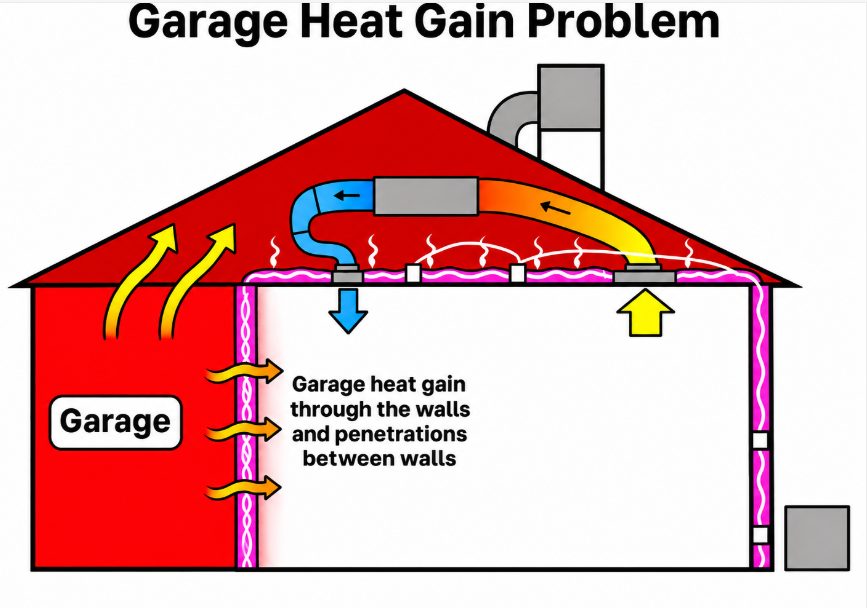
When an attached garage overheats, two primary mechanisms increase the cooling load: (1) conduction of heat through shared walls/ceilings into the home, and (2) infiltration of hot garage air into the living space when leakage pathways and pressure differences exist. In both cases, the HVAC system must remove additional heat that would not exist if the garage were cooler and more isolated.
The effect is most noticeable in rooms adjacent to or above the garage. These rooms may remain several degrees warmer than the thermostat set point, forcing longer run times and reducing the system’s ability to keep up during peak afternoon conditions.
What Are the Sources of Insufficient Garage Ventilation?
Garage overheating and garage-to-house impacts are usually caused by a combination of poor heat rejection and poor separation between the garage and the living space.
Lack of Effective Venting Path. Many garages have minimal passive ventilation. If there is no effective high/low venting path, heat accumulates and garage air temperature rises. A closed, unvented garage behaves like an oven in summer.
Garage Attic/Roof Heat Load. Garages often have attic or roof assemblies that receive heavy solar load. If the garage attic is poorly ventilated or poorly insulated, heat can build up above the garage and transfer into adjacent rooms.
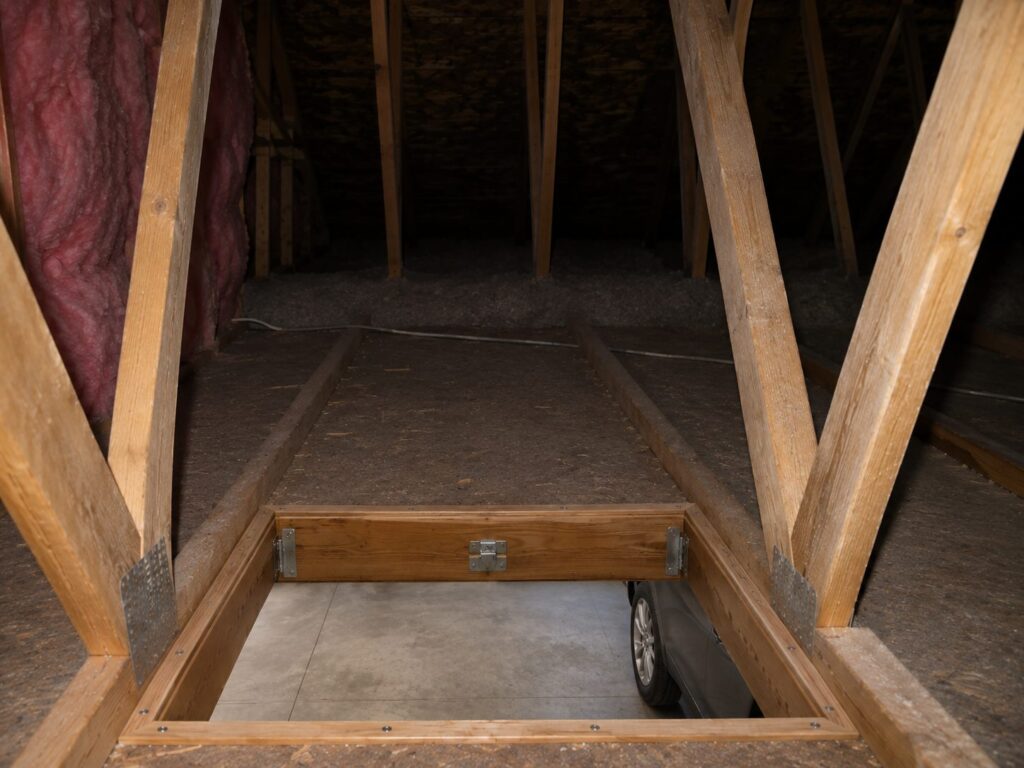
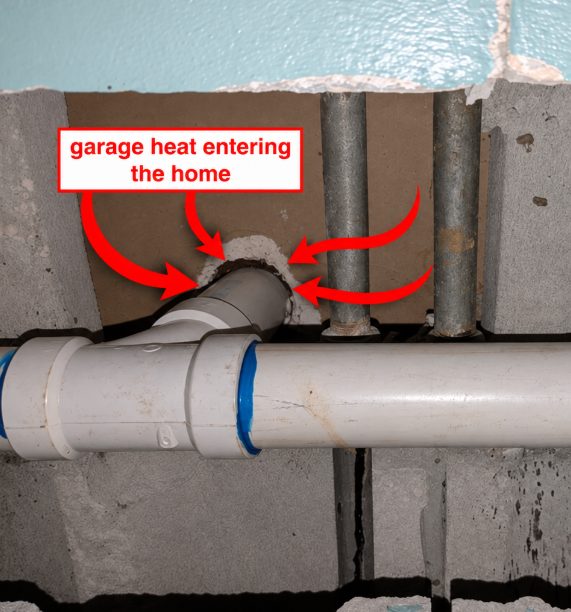
Air Leakage Between Garage and Home. Even if the garage is ventilated, comfort problems occur when the garage is not properly isolated from the home. Building America guidance emphasizes that isolating attached garages is critical for preventing infiltration of carbon monoxide and other contaminants into the dwelling.¹
HVAC Equipment or Ducts in the Garage. In some homes, ducts, air handlers, or platform returns are located in or adjacent to the garage. If any part of the return pathway is leaky or under negative pressure, it can draw hot, dirty garage air into the system and distribute it through the home, reducing delivered cooling capacity and increasing indoor air contaminants.
Additional Effects of Insufficient Garage Ventilation
In addition to comfort problems and higher utility bills, garage-to-house air exchange can create indoor air quality risks. Garages commonly store paints, solvents, fuels, and other chemicals. The U.S. Department of Energy notes that garages can be a source of multiple pollutants, including carbon monoxide from car exhaust, and recommends continuous air and thermal barriers between garages and conditioned spaces.²
Common Signs of Insufficient Garage Ventilation
Homeowners typically notice several indicators when the garage is contributing to cooling performance problems:
- Rooms adjacent to or above the garage are consistently warmer than the rest of the home
- The garage feels excessively hot compared to outdoor temperature, especially late afternoon and early evening
- Noticeable “garage” odors inside the home at certain times or when the HVAC system runs
- Drafts or temperature swings near doors, baseboards, or shared walls adjacent to the garage
- The HVAC system runs longer during peak heat but comfort issues persist in garage-adjacent rooms
For a plain-language overview of this condition, read the homeowner guide: The Room Above Your Garage Is Always Hot: Here’s the Reason.
How Professionals Confirm This Condition
Professionals confirm garage-driven comfort issues through measurement and diagnostic inspection.
Temperature Measurements. Measure garage air temperature and surface temperatures of shared walls/ceilings during peak conditions. Large differences indicate significant heat transfer potential.
Pressure and Leakage Diagnostics. Measure pressure relationships between the home and garage and inspect for leakage pathways. Building America describes a garage-to-house air barrier test method using a blower door and manometers to verify separation quality.³
Visual Inspection of the Garage-to-House Air Barrier. Inspect drywall continuity, penetrations, rim/band joists, and door weatherstripping. A smoke pen can help visualize sources of garage air leakage. Even small openings can create meaningful airflow when pressure differences exist.¹
At Knights of the Attic (KnightsOfTheAttic.com), garage-related comfort problems are treated as a combined heat-gain and pressure/leakage issue. We evaluate temperature and pressure conditions, identify leakage pathways between the garage, attic, and living space, and implement corrective measures that may include improved garage ventilation (e.g., powered attic/garage fan), garage-to-house air sealing, and attic/duct thermal upgrades. The goal is not just to “move hot air,” but to reduce the heat source and stop it from entering the conditioned space.⁴
What NOT to Do
Avoid these approaches, which can worsen performance or create safety concerns:
- Do not prop open the door between the garage and the home to “equalize” temperatures. This increases heat and pollutant transfer into the living space.
- Do not assume insulation alone will solve the problem if the garage-to-house air barrier is leaky. Air leakage must be addressed for both comfort and safety.
- Do not run a vehicle in the garage with the door closed. Carbon monoxide is dangerous and can infiltrate the home through leakage pathways.²
- Do not add supply or return vents to the garage from the HVAC system. This increases heat load, is a violation of building codes and creates safety issues. Focus on isolation and ventilation instead.
References
- ¹ DOE Building America Solutions Center. Air Sealing Attached Garage: https://basc.pnnl.gov/resource-guides/air-sealing-attached-garage
- ² U.S. Department of Energy. Insulating Floors over Unconditioned Space (pollutant and barrier guidance): https://bsesc.energy.gov/energy-basics/insulating-floors-over-unconditioned-space
- ³ DOE Building America Solutions Center. Air Leakage Testing Garage to House Air Barrier: https://basc.pnnl.gov/resource-guides/air-leakage-testing-garage-house-air-barrier
- ⁴ Knights of the Attic. Garage Temperature Control: https://knightsoftheattic.com/problems-we-solve/garage-temperature-control/
Solution: Click here to learn about solutions to this problem.