

Key takeaways
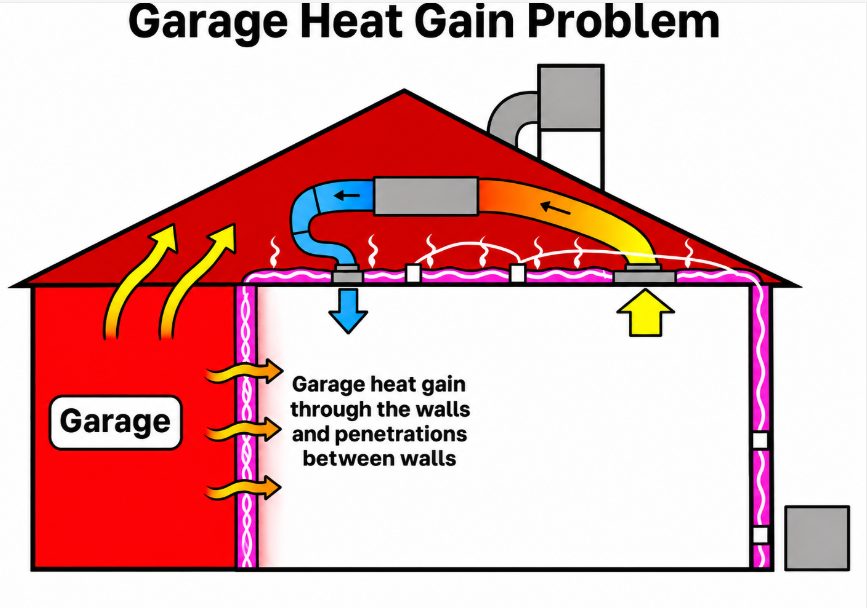
- A garage with no ventilation traps heat from the roof, the door and the slab, and that heat moves into the rooms that share a wall or ceiling with it.
- It gets in two ways: conduction through thin or missing insulation, and garage air pulled inside through gaps around pipes, wires and framing.
- Signs: the hot room touches the garage, it is worst in the afternoon and does not recover overnight, and you sometimes smell the garage indoors.
- Do not crack the garage door or run AC ducts into the garage. Seal and insulate the boundary, and ventilate the garage properly.
Walk into your garage at 3 PM on a summer afternoon.
The concrete slab radiates heat upward. The garage door, essentially a giant metal panel facing the sun, is too hot to touch. The air is stifling. Now realize that this inferno shares a wall, a ceiling, or both with your living space.
If you have a bedroom above the garage, a home office sharing a wall with the garage, or a bonus room that backs up to it, you already know the symptom: that room is always hotter than the rest of the house. No matter what you do with the thermostat, it never quite catches up.
The reason isn’t your AC. It’s a garage that’s trapping extreme heat with no way to release it, and that heat is conducting straight into your home.
Your Garage Is an Oven With No Exhaust
Most garages have massive solar exposure: a large roof area, a west- or south-facing garage door, and exterior walls baking in the Arizona sun. They also typically have minimal or no ventilation. No soffit vents, no exhaust, no airflow path. All that heat builds up with nowhere to go.
The garage slab stores heat all day and radiates it upward for hours after sunset. The garage attic space (if separate from the main attic) can be even hotter than the main attic. And the shared wall or ceiling assembly between your garage and your home becomes a slow, steady heat transfer pathway.
Two Ways Garage Heat Gets Into Your Home
Conduction through shared surfaces. Heat flows from hot to cold through the wall or ceiling between the garage and conditioned space. If the insulation in that wall is thin, missing, or bypassed, the room on the other side absorbs the heat.
Air leakage through gaps and penetrations. Pipes, wires, and framing gaps create pathways between the garage and the living space. If the home is slightly depressurized (from duct leaks or exhaust fans), garage air gets pulled inside, bringing heat, dust, odors, and harmful fumes.
Signs the Garage Is Your Hot-Room Culprit
- Rooms above or adjacent to the garage are consistently the warmest rooms
- The problem room shares a wall or ceiling with the garage
- You notice chemical or “garage” smells in the adjacent room
- The problem is worst in the afternoon and doesn’t fully resolve overnight
Want the measurements and building science behind this? Read the technical article: System Cannot Keep Up: Insufficient Garage Ventilation.
What NOT to Do
Don’t leave the garage door cracked open as “ventilation.” This can actually draw more hot outdoor air in while creating pressure patterns that push garage air into the house through leakage paths.
Don’t extend AC ducts into the garage. Conditioning the garage is expensive, inefficient, and is a code violation. The solution is reducing heat transfer and managing ventilation. A separate HVAC system, such as a mini-split, can be used to condition a garage.
How Knights of the Attic Handles Garage Heat
We treat the garage as part of your home’s overall thermal and pressure system.
We assess the garage-to-house boundary: insulation levels in shared walls and ceilings, air leakage pathways, and whether HVAC components in or near the garage are pulling in heated air.
We evaluate ventilation options that can reduce trapped garage heat without creating negative pressure that pulls air into the home.
We seal the garage-to-house interface so that heat transfer is limited to conduction through insulated assemblies, not uncontrolled air movement.
The Bottom Line
If the hottest room in your house shares a wall or ceiling with the garage, the connection isn’t coincidence. A superheated, unventilated garage is a heat source that your AC was never designed to overcome on its own.
Knights of the Attic isolates, ventilates, and insulates the garage boundary so your living space stays comfortable. If the bedroom above the garage is always the last room to cool down, the garage is almost certainly part of the equation.
Solution: Click here to learn about solutions to this problem.


