

Key takeaways
- With the door closed, the air your AC pushes into a bedroom has nowhere to go. The room builds pressure, and a pressurized room resists incoming air, so the supply register delivers less.
- The gap under the door is not enough. A typical 3/4-inch undercut gives only 15 to 20 square inches of opening, and most bedrooms need 50 to 100 square inches of free area.
- Test it tonight: close the bedroom door with the AC running and compare the bedroom with the hallway after 20 to 30 minutes. Other signs are a door that resists opening or slams when the system kicks on.
- Do not cut the door higher or leave every door open for good. The fix is a return pathway for the room: a dedicated return duct, a jump duct through the attic, or high-low or transfer grilles.
Try this experiment tonight.
Close your bedroom door with the AC running. After 20 to 30 minutes, check the temperature in the bedroom versus the hallway. If the bedroom is noticeably warmer, you’ve just demonstrated a room pressure relief problem.
Here’s what’s happening. Your AC is pushing cold air into the bedroom through the supply register. But with the door closed, that air has nowhere to go. The room builds pressure. And a pressurized room actively resists incoming air, so the supply register delivers less and less airflow as pressure builds. It’s like trying to blow up a balloon that’s already full. The more you push, the harder it pushes back.
Meanwhile, the air that does get pushed into the room escapes through the only paths available: cracks around baseboards, electrical outlets, ceiling fixtures, and the gap under the door. Some of that air gets pushed straight into the attic through ceiling leaks. And the rest of the house, now short on return air, pulls replacement air from the attic and outdoors.
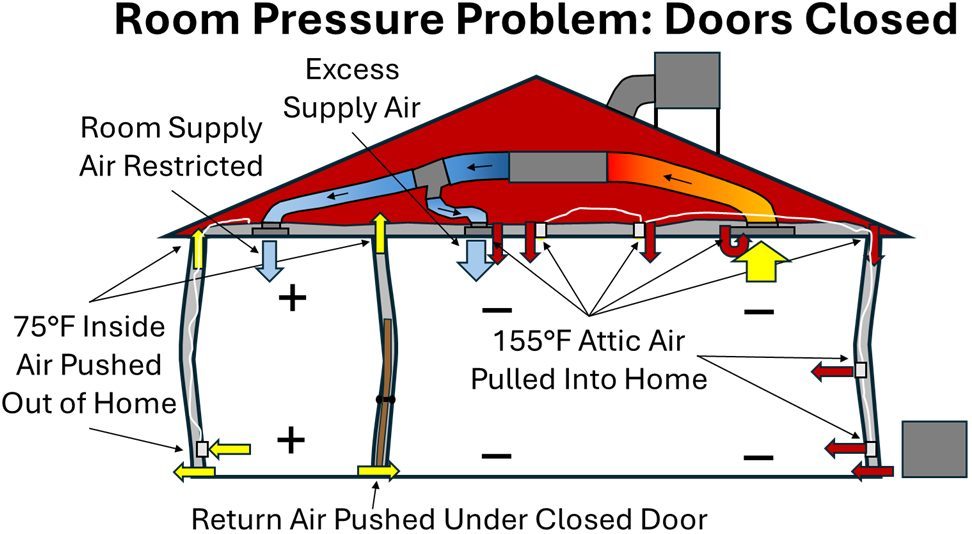
The Gap Under the Door Isn’t Enough
The most common “fix” for this problem is the gap under the bedroom door. But a typical 3/4-inch undercut provides only 15 to 20 square inches of opening. Most bedrooms need 50 to 100 square inches of free area to relieve the pressure from 80 to 120 CFM of supply air. The gap isn’t even close. Add carpet and the effective opening drops further. A master suite with 250+ CFM of supply air is an even bigger problem.
The proper solution is a dedicated return pathway, either a dedicated return duct in the room, a jump duct through the attic, or high-low / transfer grilles. These provide the airflow path the room needs without relying on a tiny door gap.
Ceiling-level pathways are preferable in cooling climates because they draw air from near the ceiling where heat accumulates, rather than pulling cooler air from the floor. This improves mixing and comfort in the room.
Signs of a Pressure Relief Problem
- Rooms get warmer when doors are closed.
- The door feels like it resists opening when the AC is running (positive pressure inside).
- You hear the door “slam” closed when the system kicks on.
- Rooms improve immediately when the door is opened.
- This happens in every bedroom with a closed door.
Want the measurements and building science behind this? Read the technical article: Hot & Cold Rooms: No Room Pressure Relief.
What NOT to Do
Don’t cut the door higher. Cutting a bigger undercut rarely provides enough area, and it compromises privacy, light blocking, and noise separation.
Don’t leave all doors open as a permanent solution. Families need doors closed for sleep, privacy, and quiet. The system should work properly with doors closed.
How Knights of the Attic Solves This
Pressure testing measures the room-to-hallway pressure difference with doors closed. We can quantify exactly how pressurized each room is.
Dedicated return, jump duct or high-low / transfer grille installation provides a properly sized return pathway for each bedroom. We install ceiling-level pathways that draw warm air from the top of the room for maximum effectiveness.
A written guarantee comes with the plan. The work is designed from those measurements, and the results are guaranteed in writing.
The Bottom Line
If your bedrooms get hot every night when the doors close, the problem isn’t your AC. It’s that the rooms have no way to breathe. Supply air goes in, but nothing can get back out to the return.
Knights of the Attic installs ceiling-level return pathways so every bedroom can cool properly with the door closed. If closed doors mean hot rooms, pressure relief is the fix.
Solution: Click here to learn about solutions to this problem.


