

Key takeaways
- A room that runs 5 to 10°F warmer than the rest of the house is not normal. Your AC is making cold air, but not enough of it is arriving in that room.
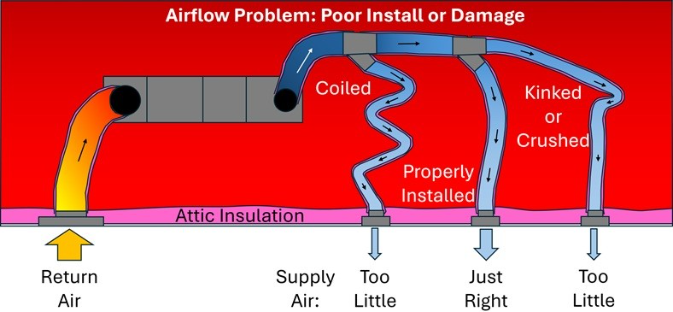
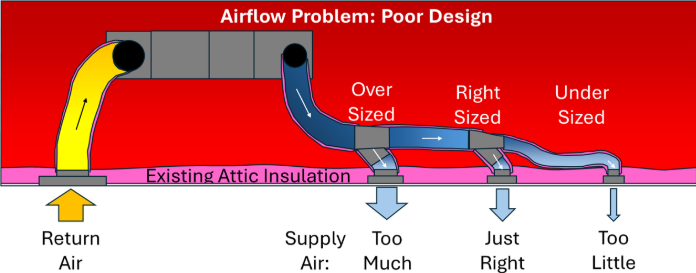
- The most common cause is the supply duct feeding the room: flex duct that is crushed, kinked, looped or sagging, a duct sized too small, a closed damper, a restrictive register or a long, winding run.
- Signs: weak or noisy airflow at that room’s register, a room at the end of a long duct run, and a room that gets even hotter when the door is closed.
- Do not close vents in the cool rooms or settle for a portable AC. Have the airflow to each room measured and the duct run inspected, then fix the specific bottleneck.
You know the room.
It’s the back bedroom. Or the master suite on the west side. Maybe it’s the kids’ room at the end of the hall. The rest of the house is comfortable. The thermostat reads 76°F. But walk into that room and it’s 82°F. You’ve tried adjusting vents, changing filters, even cranking the thermostat down. Nothing changes. That room is always the problem.
Most homeowners assume this is normal: “every house has a hot room.” But it’s not normal. It’s a delivery problem. And the most common cause is an undersized or restricted supply duct feeding that room.
The Room Isn’t Getting Enough Air
Every room in your home needs a specific amount of airflow (measured in CFM) to offset its heat gain from its walls, ceiling, windows, and internal heat sources. If the supply duct serving that room is too small, crushed, kinked, or poorly connected, the room receives less airflow than it needs. The AC is producing cold air. It’s just not arriving where it’s needed.
Think of it like a sprinkler system in a garden. If one sprinkler head is clogged or the pipe leading to it is kinked, that zone of grass goes brown while the rest of the lawn stays green. The water pressure is fine. The pump is fine. One delivery line is the bottleneck.
And because air takes the path of least resistance, the rooms with easy, short duct runs get more than their share of airflow. The rooms at the end of long, restrictive runs get whatever is left over, which often isn’t enough.
Common Causes
Restricted flex duct. The duct feeding your hot room may be crushed, kinked, looped, sagging or otherwise restricted in the attic. Even partial restriction can cut delivered airflow dramatically.
Undersized branch duct. If the duct was sized incorrectly from the beginning, it can’t deliver what the room needs.
Closed or stuck damper. A balancing damper inside the duct may have been closed and forgotten, which then starves the room of air.
Restrictive register. A register that’s too small, painted over, or blocked by furniture chokes the final delivery point.
Long, tortuous duct run. A duct that takes a winding path through the attic with multiple bends and turns accumulates so much friction that little airflow makes it to the end.
Signs Your Hot Room Has a Supply Problem
- One or two rooms are consistently warmer than the rest of the home.
- Weak airflow at the problem room’s supply register.
- The problem room is at the end of a long duct run (typically a far bedroom).
- Noisy air at the problem register (whistling or hissing).
- Closing the door makes the room even hotter.
Want the measurements and building science behind this? Read the technical article: Hot & Cold Rooms: Undersized or Restricted Supply.
What NOT to Do
Don’t close vents in cool rooms. This increases system pressure and reduces total airflow. You’re making every room worse, not redirecting air.
Don’t buy a portable AC unit as a permanent fix. That’s treating a symptom while the root cause, a duct delivery problem, continues wasting money and wearing out your system.
Don’t accept it as “normal.” A 5 to 10°F difference between rooms is a measurable, fixable problem, not an inevitable feature of your home.
How Knights of the Attic Fixes Hot Rooms
Room-by-room airflow testing measures exactly how much air each room is receiving versus how much it needs.
Attic duct inspection traces the problem room’s duct run looking for restricted sections, disconnections, or routing problems.
Targeted repairs, replacing crushed duct, properly sizing branch runs, adjusting dampers, and upgrading registers, address the specific bottleneck.
A written guarantee comes with the plan. The work is designed from those measurements, and the results are guaranteed in writing. The hot room should now be receiving the airflow it needs.
The Bottom Line
Hot rooms aren’t a mystery. They’re a delivery problem with a measurable cause and a fixable solution.
Knights of the Attic finds the restriction, fixes the delivery, and guarantees the result in writing. If you have a room that never cools down, the duct feeding it is the first place to look.
Solution: Click here to learn about solutions to this problem.


