

Key takeaways
- Attic temperature ties hot-room problems together. A properly ventilated attic might reach 130 to 140°F on a peak afternoon, while a poorly ventilated one might hit 170°F or higher.
- Blocked soffit vents, too little total vent area, unbalanced intake and exhaust, and failed attic fans all leave hot air stagnating in the attic.
- Suspect ventilation when your hot rooms sit under the roof peak or an attic pocket, the attic feels extreme, and the problem is worst in late afternoon.
- Ventilation does not fix hot rooms by itself. The biggest improvement comes from addressing it together with duct insulation, duct sealing, attic sealing and attic insulation as a system.
If you’ve read about insufficient duct insulation and ceiling insulation causing hot rooms, here’s the piece that ties it together: the temperature of the attic itself.
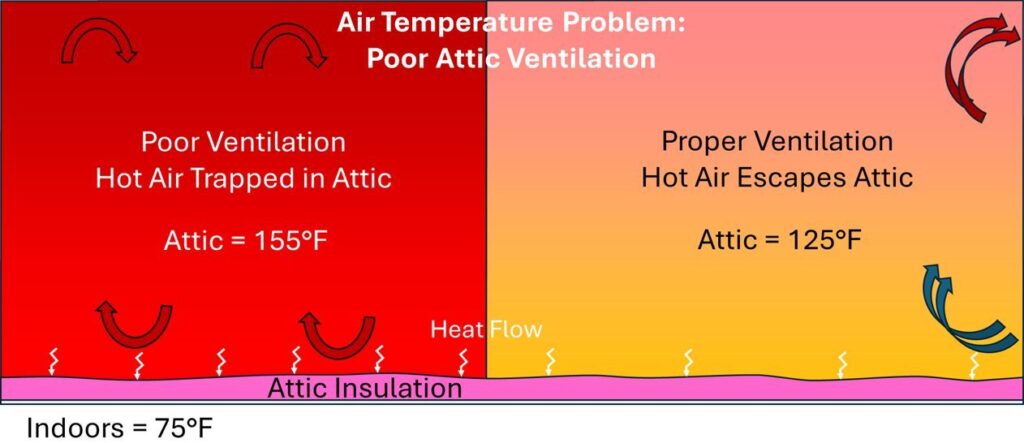
Your attic is always going to be hot in a Southwestern summer. But “how hot” varies enormously. A properly ventilated attic might reach 130-140°F on a peak afternoon. A poorly ventilated one might hit 170°F or higher. That extra 30-40 degrees doesn’t just sit there passively, it increases heat transfer through your ceiling insulation and into your duct system, making hot room problems measurably worse.
Ventilation Is a Multiplier
Attic ventilation doesn’t fix hot rooms by itself. But it reduces the severity of every thermal problem in the attic: less heat driving through the ceiling, less heat warming your supply ducts, less thermal stress on duct materials and sealants, etc. The rooms that already run hot, the ones with long duct runs, thin insulation, or corner locations, benefit the most because they’re the ones most sensitive to attic temperature.
What Goes Wrong
Blocked soffit vents prevent cooler air from entering at the eaves. Insulation, debris, or paint coverage can shut them down.
Too little total vent area means the attic can’t flush heat fast enough. The hot air stagnates.
Unbalanced intake and exhaust short-circuits the flow path. Ridge vents without soffit intake move very little air.
Failed mechanical ventilation from old attic fans reduces attic ventilation airflow. Hot air accumulates without a force to push it out.
Signs Ventilation Is Contributing to Hot Rooms
- Hot rooms are under the roof peak or in attic pockets where air stagnates.
- The attic feels extreme even by the Desert Southwest standards.
- Hot-room problems are worst in late afternoon when stored attic heat peaks.
Want the measurements and building science behind this? Read the technical article: Hot & Cold Rooms: Insufficient Attic Ventilation.
How Knights of the Attic Evaluates This
We assess ventilation as part of a complete attic performance analysis. If ventilation contributes to elevated attic temperatures, we identify whether soffit intake, exhaust, or air channel routing is the constraint. Ventilation improvements are prioritized alongside duct insulation, duct sealing, attic sealing and attic insulation, because the biggest improvement comes from addressing all of them as a system.
If your hot rooms get worse in the afternoon and the attic feels extreme, ventilation may be an amplifier worth addressing.
Solution: Click here to learn about solutions to this problem.


