
Technical article. Written for readers who want the building science. Prefer the short version? Browse the Homeowner Guides.

Key takeaways
- Hot and cold rooms usually come from room-level imbalance: some rooms get more airflow than their load needs and others get less, and the thermostat cycles the system off while those rooms are still under-served.
- Common sources are a system that was never balanced after installation, no accessible balancing dampers, friction differences between near and far rooms, register changes and missing return paths.
- Balance is confirmed by measurement: a room-level load calculation sets the target CFM, a flow hood measures each register, and total external static pressure shows whether restrictions limit airflow.
- Do not close several registers to push air elsewhere or balance by rule of thumb. Closing registers raises static pressure, reduces total airflow and can make the under-served rooms worse.
Hot and cold rooms are typically the result of room-level imbalance: the HVAC system is delivering more cooling to some rooms than they need and less cooling to other rooms than they need. When the thermostat is satisfied, the system cycles off, even if certain rooms are still under-served. This is why hot-room problems often persist for years without being “fixed” by equipment replacement.
Room comfort depends on matching delivered airflow (CFM) to each room’s cooling needs. If airflow is not balanced, temperature differences will be predictable: high-airflow rooms become overcooled while low-airflow rooms become warm, especially during peak summer conditions.
Cause: Improper Air Balance
A common cause of hot and cold rooms is improper air balance, meaning the supply and return airflows are not proportioned correctly across the home. Air balance issues can exist even if the ductwork is not visibly damaged. In many cases, the system was never balanced after installation, or later changes (remodeling, register replacements, duct repairs, or homeowner adjustments) altered airflow distribution.
Improper air balance can show up as either insufficient room airflow (hot rooms) or excess room airflow (overcooled rooms, high velocity, or noise). It is also closely tied to static pressure and duct sizing. When ducts are restrictive or undersized, the “available airflow” is limited, making proper balancing harder and increasing the severity of the imbalance. See also Hot & Cold Rooms: Undersized or Restricted Supply and System Cannot Keep Up: Undersized or Restricted Return.
Why Does Improper Air Balance Create Hot Rooms?
Room cooling capacity is a function of both airflow and air temperature delivered. If a room’s calculated load requires 120 CFM but it only receives 70 to 80 CFM due to an imbalanced distribution, the room will not receive enough sensible cooling to maintain set point. ACCA Manual J and Manual D methods are designed around matching room airflow targets to room loads; when the delivered airflows do not match the design intent, room-to-room comfort becomes uneven.¹
Imbalance is often self-reinforcing. If one branch receives too much airflow, it can increase noise and cause occupants to partially close registers. That raises static pressure, reduces total system airflow, and can make the under-served rooms even worse. A correct fix is not “guessing damper positions,” but measuring room CFM and adjusting distribution to achieve targets while keeping total external static pressure within acceptable limits.2
What Are the Sources of Improper Air Balance?
Air balance problems usually originate in design, installation, or later changes.
No Balancing Dampers. Many duct systems were installed without accessible balancing dampers, making distribution dependent on duct friction and register type alone.
Duct Layout and Friction Differences. Rooms closer to the air handler often receive more airflow due to lower friction, while far rooms receive less. Without balancing, this “path of least resistance” effect is common.
Register and Grille Differences. Swapping registers (different free area), closing registers, or adding restrictive decorative grilles changes airflow distribution and can create new hot rooms.
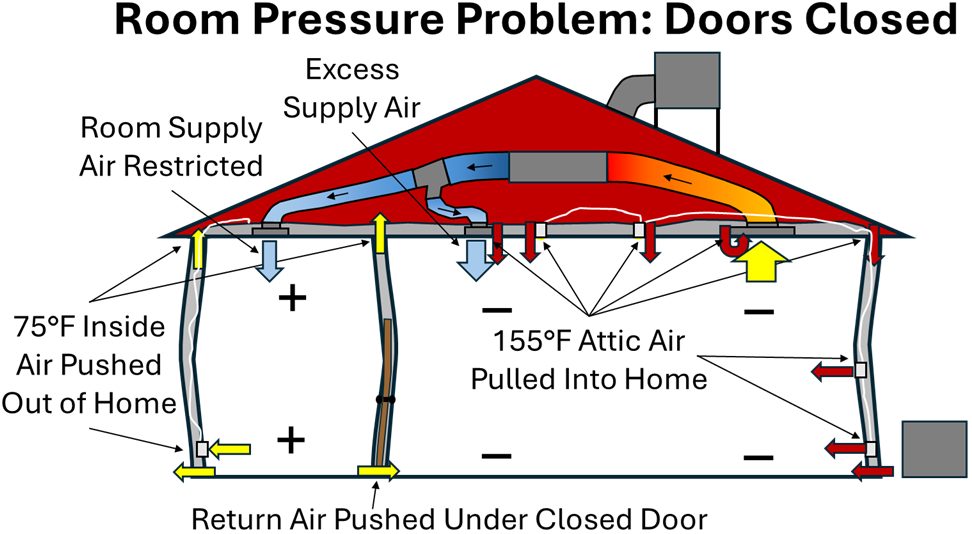
Return Air Path Issues. If return pathways are insufficient in certain zones (closed doors, no transfers/jump ducts), the room can become pressure-isolated and lose effective supply airflow. This overlaps with Hot & Cold Rooms: No Room Pressure Relief.
System Changes Over Time. Filter upgrades, coil fouling, blower setting changes, or duct repairs can change system operating point and alter distribution. If the system was “barely balanced” before, these changes can push it out of balance.
Additional Effects of Improper Air Balance
Air balance problems affect more than comfort:
Higher Energy Use. Under-served rooms drive occupants to lower the thermostat, increasing runtime for the entire home.
Noise and Draft Complaints. Over-served rooms may have high face velocity at registers, causing noise and uncomfortable drafts.
Equipment Stress. Attempts to “force” airflow by closing registers or adding restrictive filters increase static pressure and can stress the blower. This is closely related to High Utility Bills & Premature Equipment Failure: Undersized or Restricted Supply.
Common Signs of Improper Air Balance
Common indicators include:
- Some rooms are consistently hot while others are consistently cold.
- Certain registers are loud or have excessive air velocity.
- Closing a door to a room makes that room noticeably warmer (pressure/return path issue).
- Airflow varies significantly between rooms even when registers appear open.
- Comfort problems persist even after basic maintenance (clean filter, clean outdoor coil).
For a plain-language overview of this condition, read the homeowner guide: Your AC Is Playing Favorites, and Some Rooms Are Losing.
How Professionals Confirm This Condition
Air balance is confirmed through measurement, not opinion.
Room-by-Room Airflow Targets. Calculate an accurate room-level heat load to determine the target airflow CFM for each room for even temperatures and proper comfort.
Room-by-Room Airflow Testing. Use a flow hood or equivalent method to measure supply airflow at each register. Compare measured CFM to target CFM derived from room load calculations or validated performance targets.
Static Pressure Measurement. Measure total external static pressure (TESP) to confirm whether the system is operating within manufacturer limits. High static pressure can indicate restrictions that limit total airflow and complicate balancing.
Balancing Procedure. Adjust balancing dampers, register settings (as needed), and in duct modifications as needed to bring each room within its target airflow range. Confirm that total airflow and temperature split remain acceptable.
KOTA Workflow. Knights of the Attic’s Air Flow Services include calculating room-level target airflows via a 3D scan of your home, adding balancing dampers, adding returns/jump ducts/transfer grilles, and performing professional air balancing so every room receives the airflow it needs.3
What NOT to Do
Avoid these common mistakes:
- Do not close multiple supply registers to “push air” to another room. This usually increases static pressure and reduces total airflow.
- Do not rely on “rule of thumb” balancing without calculating target and measuring actual CFM. Without a clear target and actual measurements, air balancing is just a guess.
- Do not assume airflow issues are refrigerant issues. Distribution problems often mimic low capacity complaints.
- Do not ignore return pathways. A room without pressure relief cannot reliably receive design airflow when its door is closed.
References
- 1 ACCA Manual J (Residential Load Calculation) and ACCA Manual D (Residential Duct Systems).
- 2 DOE Building America Solutions Center. Pressure Balancing Supply and Return Ducts in Existing Homes: https://basc.pnnl.gov/information/pressure-balancing-supply-and-return-ducts-existing-homes
- 3 Knights of the Attic. Duct Services: https://knightsoftheattic.com/duct-services/
Solution: Click here to learn about solutions to this problem.


