Technical article. Written for readers who want the building science. Prefer the short version? Browse the Homeowner Guides.

Key takeaways
- When the return side is undersized or restricted, the system cannot move enough air to deliver its rated cooling capacity, so it runs longer and still misses the setpoint on hot afternoons.
- The restriction usually has more than one source: return ducts or filter grilles sized too small, a loaded or high-MERV filter, crushed, kinked or sagging ducts, and bedrooms with no return path when the door is closed.
- Left alone it compounds: higher static pressure raises duct leakage, strains the blower, loads the coil with dust, hurts humidity control and can ice the coil.
- A static pressure test, airflow measurement, grille and duct sizing checks and a visual inspection confirm it. Adding refrigerant, raising blower speed or closing registers does not fix it.
Summertime temperatures are extreme in the Desert Southwest. The HVAC systems in many homes are unable to maintain the temperature at the thermostat set point during the afternoon heat. This leads to comfort problems inside the home. If the HVAC system continues to struggle to recover after the sun goes down, the comfort problems are amplified because it becomes difficult for home occupants to sleep.
Cause: Undersized or Restricted Return
One cause of this problem is an undersized or restricted return. The return side of the HVAC system is the intake. It pulls air from the home, passes it through a filter, moves it across the evaporator coil for cooling, and delivers it back to the home through the supply ducts. When the return pathway is undersized or restricted, the system cannot move enough air to deliver its rated cooling capacity. The equipment runs longer, works harder, and still fails to reach the thermostat setpoint during peak demand.
Why Does an Undersized or Restricted Return Reduce Cooling Capacity?
HVAC equipment is designed to move a specific volume of air across the evaporator coil. Residential systems in the Southwest should be designed to operate at 400 to 425 CFM/ton. That is to ensure maximum cooling capacity and efficiency is achieved in our hot, dry climate. A 3-ton system requires approximately 1,200 to 1,275 CFM to deliver its rated capacity. When return airflow is restricted, the blower cannot pull enough air through the system. Less air crossing the coil means less heat absorbed from the home, regardless of how long the equipment runs.¹
The restriction also forces the blower motor to work against elevated static pressure, or air pressure inside the duct system. This further reduces airflow at exactly the time when cooling demand is highest. The extra stress on the blower causes it to generate more heat during this time introducing a new heat source to the home. A system that delivers adequate cooling during mild weather may fall significantly short when outdoor temperatures exceed 110°F. A meaningful airflow shortfall (for example, 15 to 25%) can reduce delivered cooling capacity by a similar magnitude and push the system out of its rated performance range during peak outdoor temperatures.
What Are the Sources of Undersized or Restricted Return?
Return restriction comes from a variety of sources, and most homes have more than one contributing factor.
Undersized Return Ducts. Return ducts that are too small for the system tonnage create a permanent airflow bottleneck. This is a design problem that cannot be overcome by filter changes or maintenance. ACCA Manual D provides sizing calculations based on friction rate and equivalent length. Many homes in the Southwest were built with return ducts sized for equipment that had high-horsepower, low-efficiency motors common at the time that could overcome the air restriction. When equipment was upgraded to lower-horsepower, higher-efficiency models, the return ducts were not enlarged to match.²
Undersized Filter Grilles. Filter grilles that are too small for system airflow create high face velocity at the filter and grille. This increases pressure drop and reduces airflow. Installing higher-MERV filters on undersized grilles compounds the restriction. A filter grille that works adequately with a MERV 8 filter may become severely restrictive with a MERV 13 filter because the denser media requires more surface area to maintain acceptable pressure drop.
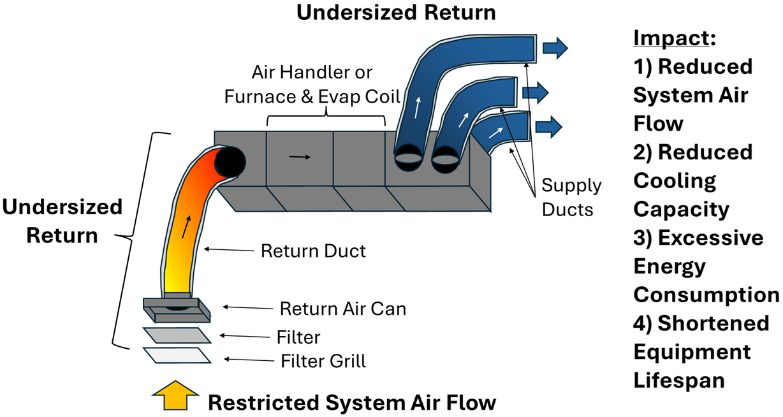
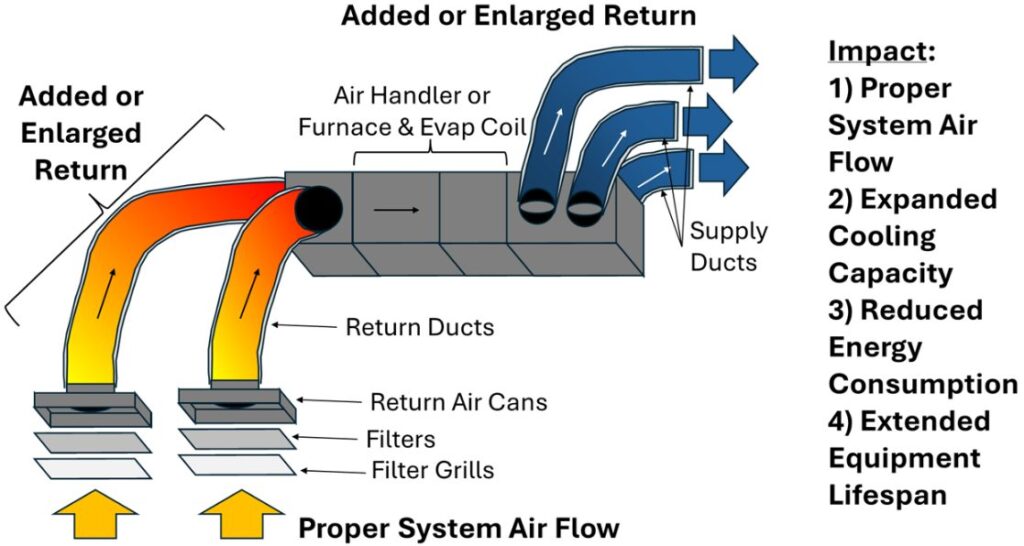
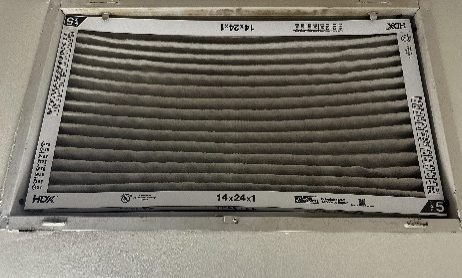
Dirty or Restrictive Filters. Clogged filters that are not regularly replaced will progressively increase air restriction over time. High-MERV filters installed without adequate filter surface area create excessive pressure drop even when new. The pressure drop across a filter increases as it loads with captured particles, so a filter that starts at an acceptable pressure drop of 0.15″ w.c. may reach an excessive pressure drop of 0.40″ w.c. or higher before the homeowner notices reduced performance.
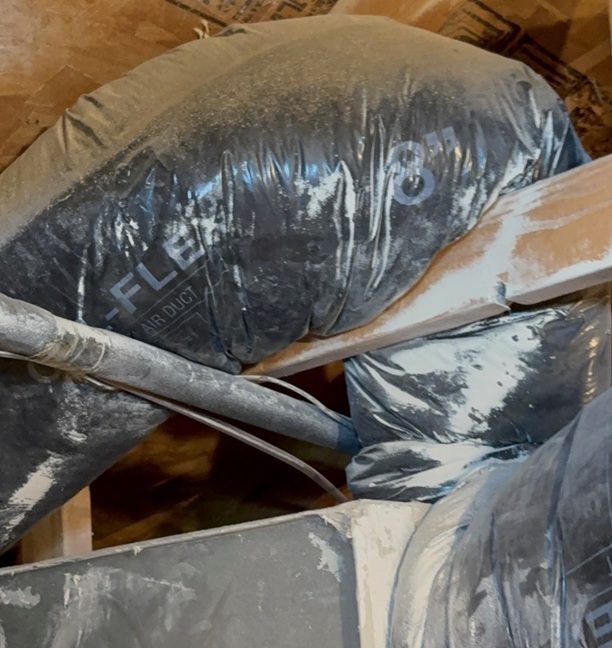
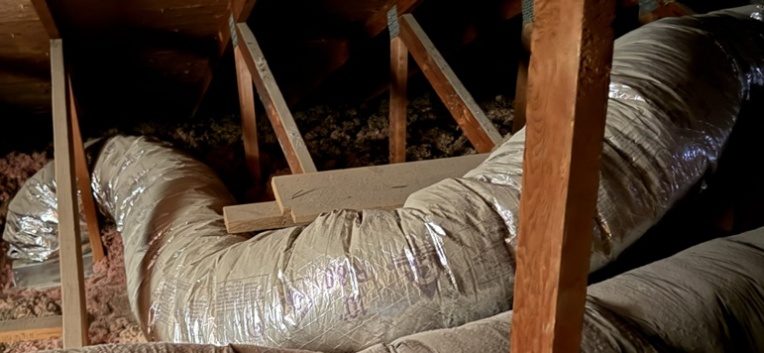
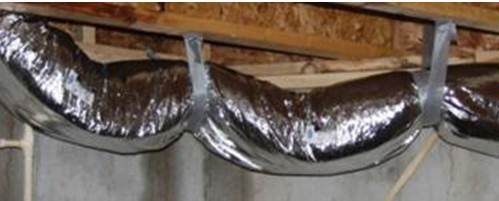
Restricted Duct. Ducts that are crushed, kinked, coiled, looped, or sagging create pinch points that restrict airflow. Even partial compression significantly increases air friction and loss of airflow volume. A duct compressed to half its diameter can have several times the friction loss of a fully open duct of the same length. Flex duct is more susceptible to restrictions, but metal ducts can also be crushed when homeowners or workers are maneuvering through an attic.³



Inadequate Return Pathways for Closed Rooms. Homes with a single central return and no dedicated return pathways for bedrooms experience airflow restriction when doors close. The closed rooms pressurize while the return area depressurizes, reducing total system airflow. Door undercuts alone are often insufficient for proper pressure relief. A typical 3/4″ undercut provides only 15 to 20 square inches of opening, far less than the 50 to 100 square inches needed for adequate transfer.
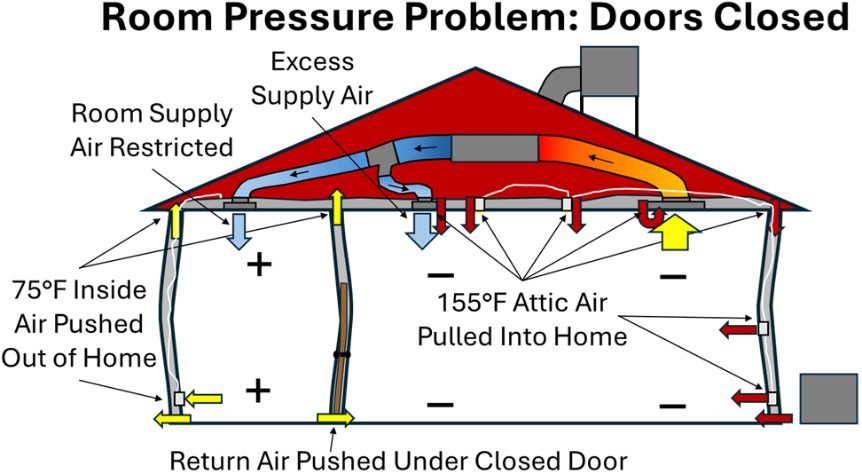
Installing a ducted return in each bedroom helps eliminate this pressure imbalance and provides an additional return pathway to reduce a restricted return.⁴ Ceiling-level jump ducts or high-mounted transfer grilles are more effective than floor-level solutions because they draw air from near the ceiling where heat accumulates during cooling season, rather than pulling cooler stratified air from floor level.
Additional Effects of Undersized or Restricted Return
Beyond the immediate comfort problem, restricted return airflow creates a cascade of secondary effects that compound over time.
High static pressure increases duct leakage. Any existing leaks in the duct system lose more conditioned air when pressure rises. This means hot attic air enters through return leaks while conditioned air escapes through supply leaks, further reducing system cooling capacity. A duct system that leaks 15% at normal operating pressure may leak 20% or more when static pressure is elevated by restriction.
The blower motor draws more power and generates excess heat when working against elevated static pressure, shortening motor life. ECM motors attempt to maintain airflow by increasing speed, which increases energy consumption. PSC motors simply deliver less air as static pressure rises, with corresponding capacity loss.
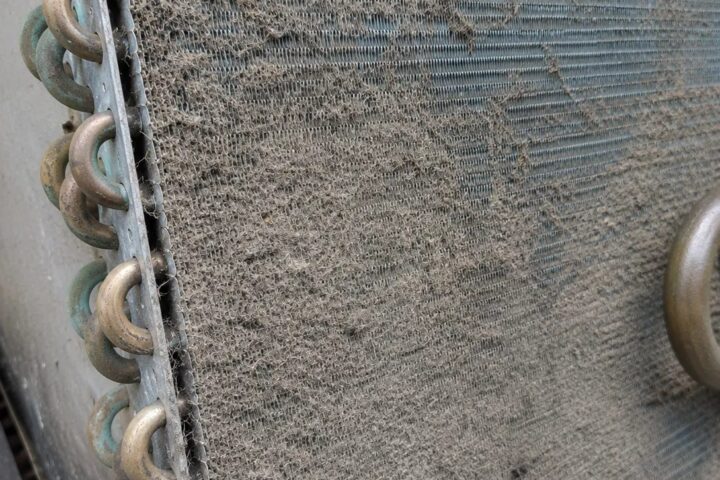
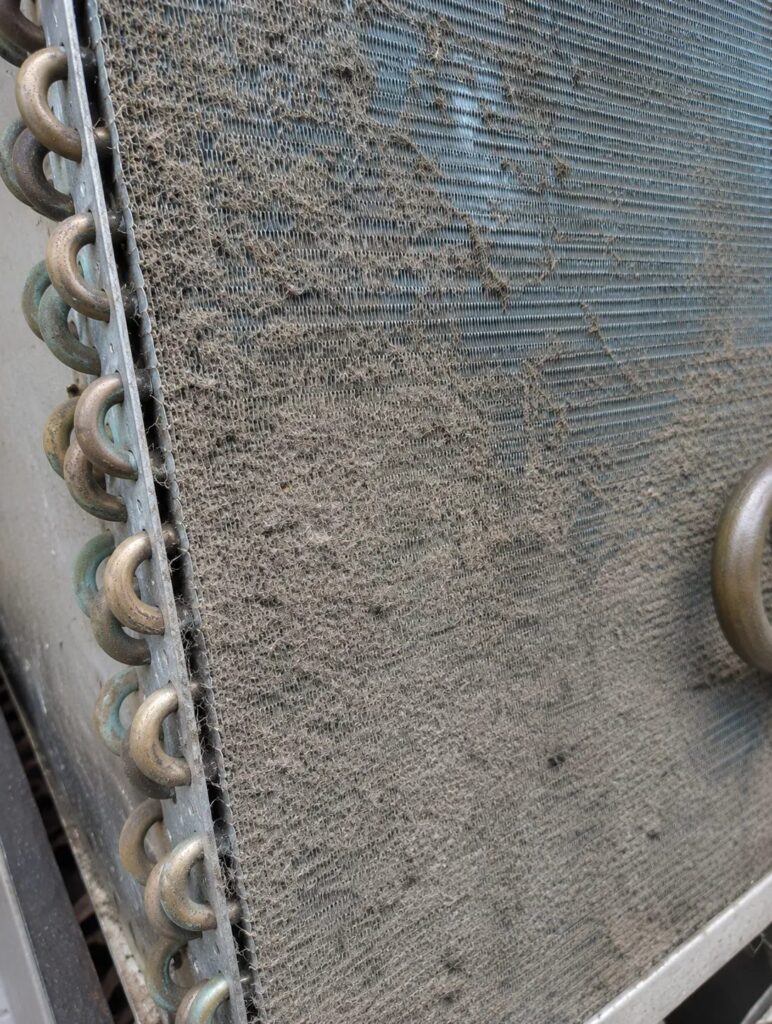
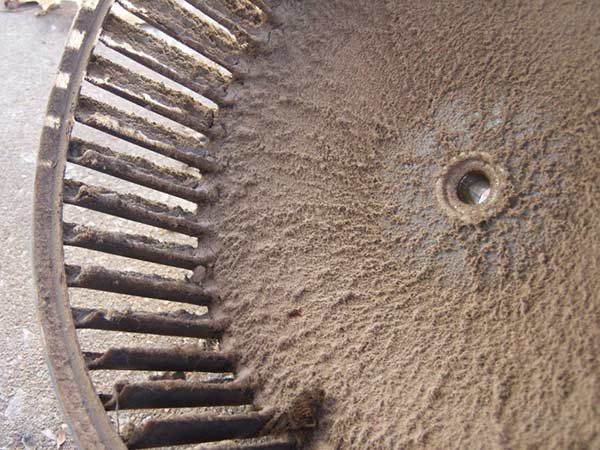
Filters load faster under high velocity and are more likely to bypass around the edges, allowing dust and particulates to contaminate the evaporator coil and blower wheel. A dirty coil further reduces heat transfer, compounding the original capacity problem. Once the coil is contaminated, cleaning or replacement becomes necessary, a cost that could have been avoided by addressing the restriction.
Humidity control also suffers. Reduced airflow means less moisture removal per hour. If the coil runs too cold from low airflow, it may freeze before it can dehumidify effectively. The result is a home that feels clammy even when the temperature is acceptable.
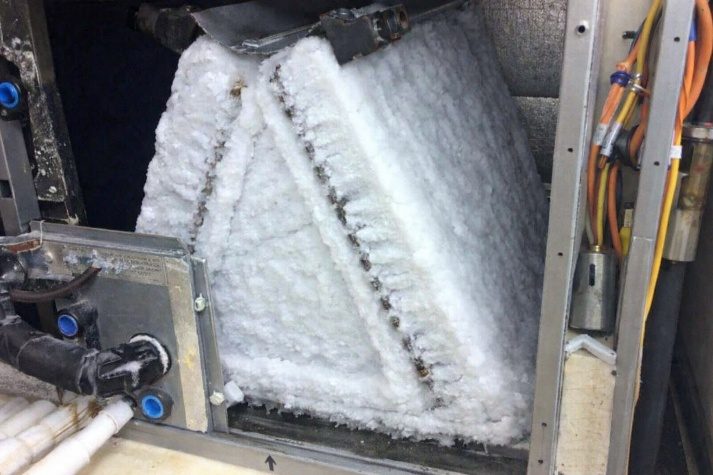
If airflow restriction is severe, the evaporator coil temperature can drop below freezing and ice forms on the coil. This further blocks airflow and can lead to liquid refrigerant returning to the compressor, risking compressor damage. Compressor replacement is one of the most expensive HVAC repairs; restricted return airflow is one of the preventable causes.
Common Signs of Undersized or Restricted Return
Homeowners typically notice several indicators when return airflow is restricted:
- System runs constantly but cannot reach the thermostat setpoint on hot days.
- Weak airflow at supply registers throughout the home.
- Whistling or rushing noise at the return grille or filter location.
- Filter visibly bowed inward or sucked tight against the grille during operation.
- Interior doors slam shut or become hard to open and close when the system runs.
- Ice visible on refrigerant lines or evaporator coil (in severe cases).
- Blower motor sounds louder or more strained than normal.
- Filters load with dust faster than expected.
- Dust streaks visible around return grille edges indicating air bypass.
- House feels humid even when the temperature is acceptable.
For a plain-language overview of this condition, read the homeowner guide: Why Your AC Can’t Keep Up, and the Hidden Culprit in Your Return Ducts.
How Professionals Confirm This Condition
Professionals use measurements and inspections to confirm a return restriction.
Total External Static Pressure (TESP) Measurement. The primary diagnostic test is measuring Total External Static Pressure across the equipment and comparing it to the manufacturer-specified blower performance table found in installation documentation. Many residential air handlers provide less airflow as external static pressure increases. Operating equipment beyond the manufacturer’s maximum allowed TESP can void the warranty of the equipment and lead to premature failure.⁵
Airflow Measurement. Airflow can be measured using an anemometer or flow hood at return registers. The total should be compared to equipment requirements, approximately 400 to 425 CFM per ton for most cooling equipment in the Southwest.
Duct System Measurement. Measurements of return grill, filter and duct sizing relative to system tonnage provide an accurate estimate of potential areas of airflow restriction.
Visual Inspection. Visually inspecting the duct system to look for restricted ducts and identifying blocked grilles or furniture placement helps identify sources of restricted airflow.
At Knights of the Attic, we use each of these techniques to identify the source of return airflow restriction in your system and design customized solutions to correct any restriction in your home.
What NOT to Do
Certain responses to a system that is unable to keep-up due to a return airflow restriction make things worse rather than better.
- Do not add refrigerant to solve this problem. Abnormal pressures from low airflow are not a refrigerant charge issue. Adding refrigerant to a system with restricted airflow can result in liquid refrigerant flooding back to the compressor, causing damage.
- Do not increase blower speed as a permanent fix if ducts or grilles are the limiting factor. This increases static pressure and accelerates motor wear without addressing the underlying restriction. The system will consume more energy while still failing to deliver adequate cooling.
- Do not assume a dirty filter is the only cause. Filter replacement helps but does not fix undersized ducts or grilles. If the filter is clean and restriction persists, the problem is elsewhere in the return components.
- Do not lower the thermostat setpoint expecting the system to catch up. This extends runtime without addressing capacity loss, increases energy consumption, and may cause the coil to ice over.
- Do not close supply registers in other rooms hoping to redirect air to problem areas. Closing registers increases system static pressure, reduces total airflow, and makes the restriction worse.
References
- ¹ ACCA Manual S: Residential Equipment Selection. Air Conditioning Contractors of America. https://www.acca.org/standards/manuals
- ² ACCA Manual D: Residential Duct Systems. Air Conditioning Contractors of America. https://www.acca.org/standards/manuals
- ³ DOE Building America Solutions Center. Sealed and Insulated Metal Ducts: https://basc.pnnl.gov/resource-guides/sealed-and-insulated-metal-ducts
- 4 DOE Building America Solutions Center. Ducted Returns: https://basc.pnnl.gov/resource-guides/ducted-returns
- ⁵ Equipment manufacturer installation instructions provide maximum external static pressure specifications and blower performance tables for specific models.
Solution: Click here to learn about solutions to this problem.