Duct Replacement · Arizona · Inspected First, Never Assumed
Duct Replacement for Arizona Homes. Not Every Duct Needs Replacing. We Find Out Which Ones Do.
Flex ductwork in an Arizona attic doesn’t fail all at once. It fails in stages, run by run, and the right fix depends on the stage each run is in. Knights of the Attic inspects the condition and performance of your entire air duct system first, then recommends only what the findings support: preserving ducts that can still be saved, replacing the sections that have failed, or replacing and redesigning the system when that is what your home actually needs.


How Flex Duct Fails
Three Layers, Failing From the Outside In
Flexible ductwork is three layers doing three jobs. They don’t fail together, and they don’t fail at the same speed. Understanding the order explains why a run can look rough on the outside and still be worth saving, and why a run that has failed on the inside can’t be.
Click or tap a layer to highlight it
-
The thin protective skin on the outside of the run. It takes the attic heat, the UV wherever light reaches, and the years. It is the first layer to dry out, crack, and peel.
-
The blanket between the attic and the air inside the duct. It only works while the jacket keeps it covered and in place. Once exposed, it sags, falls away, and stops protecting the run from attic heat.
-
The wire-reinforced core that actually carries your conditioned air. Left unprotected, it becomes brittle, tears, and pulls apart at joints and bends. When the liner fails, the run is done.
Failure works from the outside in. That is why the stage of each run, not just its age, decides what it needs. We describe those stages three ways.
Flex duct cutaway: jacket, insulation, inner liner
The Three Stages of Duct Failure
Duct Failure Isn’t All-or-Nothing. It Happens in Stages.
Every flex duct run in your attic sits somewhere on this scale, and runs in the same attic are often at different stages. Knowing which is which is the difference between replacing a whole system and replacing only the parts that have actually failed.
-
Stage 1Initial Failure
The jacket is going. The duct still works.

Layer condition
- Outer jacket Compromised
- Insulation Intact
- Inner liner Intact
What you would see
- Outer jacket peeling, cracking, or flaking
- Jacket dry and brittle to the touch
- Insulation still covered and in place
- Inner liner sound; airflow often still normal
What it means
The run still delivers air, but its outer protection is failing. Once the jacket opens, the insulation underneath is exposed to attic heat and the run starts down the path to Stage 2. Caught here, the duct can often be preserved instead of replaced.
Typical path Preserve with Insulated Duct Armor™
-
Stage 2Partial Failure
The jacket has opened. The insulation is going.

Layer condition
- Outer jacket Failed
- Insulation Compromised
- Inner liner Compromised
What you would see
- Jacket split open or deteriorated away in places
- Insulation exposed, sagging, or falling out
- Inner liner exposed and starting to show wear
- Air arriving warmer, especially on hot afternoons
What it means
The duct has lost most of its protection from attic heat and is increasingly vulnerable. Depending on what the inspection finds, individual sections may need to be replaced while other portions of the system can still be preserved or protected.
Typical path Replace failed sections, protect the rest
-
Stage 3Complete Failure
Every layer has failed. The run is done.

Layer condition
- Outer jacket Failed
- Insulation Failed
- Inner liner Failed
What you would see
- Jacket and insulation fully compromised
- Inner liner torn, separated, or collapsed
- Runs pulled apart at joints, boots, or fittings
- Conditioned air blowing into the attic, not the room
What it means
Conditioned air now leaks heavily into the attic instead of reaching the rooms, and there is nothing left to protect. At this point the failed ductwork generally needs to be replaced rather than preserved.
Typical path Replace the failed ductwork


A stage describes a duct run, not a whole system. Most attics we inspect contain more than one stage at once, which is why the recommendation is built run by run rather than from the worst section we find.
Follow One Run
How a Single Duct Run Goes From Stage 1 to Stage 3
Select a stage to see what has failed on the run, what is still holding, and what that usually means for the fix.
Stage 1 · Initial FailureStage 2 · Partial FailureStage 3 · Complete Failure
- Outer jacket CompromisedFailedFailed
- Insulation IntactCompromisedFailed
- Inner liner IntactMostly intactFailed
Stage 1 · Initial Failure
The jacket dries, cracks, and starts to flake.
Underneath, the insulation and inner liner are still doing their jobs. The run delivers air normally; only its outer protection is going.
Preserve with Insulated Duct Armor™
Stage 2 · Partial Failure
The jacket opens. The insulation is exposed and starts falling away.
Attic heat now reaches the air inside. The liner is still mostly intact, but the run has lost most of its protection and is getting worse every summer.
Replace failed sections, protect the rest
Stage 3 · Complete Failure
With nothing protecting it, the liner tears and separates.
Conditioned air pours into the attic instead of the room. There is nothing left to preserve; this run gets replaced.
Replace the failed ductwork
See the four possible outcomesThe earlier a run is caught, the more of it can be saved. That is the whole case for inspecting before replacing.
The Inspection Decides
Four Possible Outcomes. The Findings Choose Between Them.
We don’t pick an outcome and then look for reasons. The inspection stages every run, and the recommendation follows from what it finds.
Free Duct & Attic Assessment
Every accessible run staged, the whole system tested, the layout reviewed.
-
Preserve and Protect
Jacket failing, insulation and liner intact: sealed and protected in place with Insulated Duct Armor™.
Stage 1
-
Replace Individual Sections
Failed runs and fittings replaced; the sound sections stay and are protected.
Stage 2beside Stage 1
-
Replace Larger Portions
Widespread failure or a layout causing comfort problems: larger portions replaced and redesigned.
Stage 2Stage 3
-
Full Replacement and Redesign
System failed throughout, or a layout that can’t deliver: replaced with a layout designed for the home.
Stage 3 throughout
Most attics are a mix. It is common to find Stage 1 runs beside Stage 3 runs in the same home, and the recommendation reflects that mix, not the worst run we found. If your duct system doesn’t need replacing, that is exactly what we’ll tell you.
Duct Failure Over Time
Duct Failure Doesn’t Cost You in a Straight Line. It Compounds.
Even a duct that never fails costs a little more to run each year, because energy prices and inflation keep climbing. A failing duct does something different: once the jacket goes, your utility bill, your HVAC runtime, and the dust in your air all start climbing on their own, slowly at first and then steeply. From initial to complete failure, that slide often plays out over 5 to 10 years.
What climbs
- Utility bill
- HVAC runtime
- Dust and air quality
- Real duct (failure)
- Theoretical duct (no failure)
- Insulated Duct Armor™
Why the no-failure line still risesInflation and higher energy costs, year over year. Not the duct. Still rises without failing: inflation and energy costs, not the duct.
- Today
- InitialStage 1
- PartialStage 2
- CompleteStage 3
Illustrative, not to scale.
-
The climbing curve: a real duct
A real duct follows the baseline until the jacket cracks. Stage 1 barely registers on the bill. By Stage 2 the insulation is exposed and the curve bends. By Stage 3 the liner is open, and utility cost, runtime, and dust climb steeply together.
-
The flat line: a duct that never fails
Even a duct that never fails creeps up a little over the years. That slope is not the duct: it is inflation and rising energy costs, year over year, making the same system cost more to run. That gentle rise is the baseline every real duct is measured against.
-
The dashed line: Insulated Duct Armor™
A run preserved with Insulated Duct Armor holds a flat line across the same span, tracking below the theoretical duct instead of following the failure curve. It is the Stage 1 path from the three stages above.
Where your ducts sit on this curve today is exactly what the free assessment finds out. Catch a run at Initial and it can usually be preserved. Wait until Complete and replacement is the only option left.
Stage 1 Preservation
When the Jacket Is Failing but the Duct Still Works, Preservation Can Beat Replacement.
For runs at Stage 1, where the outer jacket is deteriorating but the insulation and inner liner are intact, Insulated Duct Armor™ seals, insulates, and protects the duct in place, shielding it from the attic heat that would otherwise carry it into Stage 2. It also protects the sound sections of a partially replaced system, and can protect a fully replaced system against the same heat that wore out the last one. It is one possible recommendation, and only the inspection decides whether it is the right one for your home.
- Seals vulnerable duct gaps and connections
- Adds a protective insulating barrier against extreme attic heat
- Helps conditioned air reach the rooms where it belongs
- Helps extend the life of the duct system
Replacement and Redesign
Duct Replacement Built Around Your Rooms, Not Around Your Old Layout
New duct in the old configuration gives you the old problems with a new price tag. Flip the plan to see what changes when the layout is designed for the rooms instead of inherited from the last install.
Same-layout swap: new material on the same long, kinked runs, with the same single return. The rooms that struggled before struggle after. Knights of the Attic redesign: runs rerouted and resized, a second return added, every room fed for what it actually needs, and the whole system protected from attic heat.
- Original run
- Redesigned run
- Return
- Hot room
- Even room
-
Evaluate the existing layout
Where the design itself, not just the duct condition, is holding comfort back.
-
Replace failed sections
Stage 2 and Stage 3 runs and fittings replaced; sound sections stay and are protected.
-
Redesign and reroute
Long, kinked, or crushed runs rerouted or resized so air reaches the rooms it was meant for.
-
Airflow and room comfort
Hot rooms and weak vents treated as design problems, with airflow tested before and after.
-
Supply and return configuration
Both sides reviewed together, because a system that can’t pull air back can’t push it out.
-
Insulate or protect the system
A few sections or the entire system, protected against the attic heat that wore out the last one.
A same-layout swap isn’t wrong for every home. When the layout already works and the whole system has failed, replacing it in place is exactly what we recommend. The inspection makes that call, not the estimate.
Inspection First
Before We Recommend Replacing Anything, We Inspect the Entire System.
Duct replacement is a big decision, and it should be made from evidence. The Free Duct & Attic Assessment looks at the condition of every accessible run and the performance of the system as a whole, so the recommendation fits your attic rather than a template.

- Every run staged: jacket, insulation, liner
- Joints, boots, and plenums checked
- Airflow tested at every register
- Delivered-air temperature measured
- Return paths and room pressure
- Layout reviewed against each room
- Photos and thermal images
Real Homeowners
What Valley Homeowners Say
Reviews from homeowners we’ve helped across Arizona, pulled live from Google.


Good Questions
Duct Replacement Questions Homeowners Ask Us
Yes. The full duct and attic inspection, room-by-room airflow and temperature testing, photos and thermal images, findings review, and any recommendations are free, with no obligation. You decide what, if anything, happens next.
Not necessarily. Flex duct fails in stages and run by run, so many attics have runs that can be preserved right beside runs that have failed. The inspection stages every accessible run, and the recommendation follows from that: protection, replacing individual sections, replacing larger portions, or a full replacement when the whole system has failed.
There is no single price, because no two attics need the same work. What drives the number is how many runs have actually failed, how much of the system can be preserved instead of replaced, how accessible the attic and the runs are, the size and layout of the system, and whether the layout itself needs redesigning rather than rebuilding as it is. A home with a few failed runs beside sound ones is a very different job from a system that has failed throughout, which is why we stage every accessible run before recommending anything. You will see the findings and what each option involves before you decide.
Often, when the failure is caught early. A run whose outer jacket is cracking or peeling but whose insulation and inner liner are intact can usually be sealed, insulated, and protected in place with Insulated Duct Armor™. Once the inner liner has torn or separated or the outer liner has fully failed, that run needs to be replaced rather than preserved.
New duct fixes the problems caused by duct condition: leaks, exposed insulation, torn liners. Problems caused by the layout, such as long or undersized runs, poor register placement, or weak return paths, need a redesign, not just new material. That is why we evaluate the layout as well as the condition before recommending anything.
It can, when the layout is part of the problem. Sometimes the existing routing works and the system is replaced in place. Other times runs are rerouted or resized, or the supply and return configuration is changed, so every room receives the air it needs. The inspection findings decide which.
Insulated Duct Armor™ is our proprietary solution for sealing, insulating, and protecting attic ductwork. It helps significantly reduce leakage, defend against extreme attic heat, improve delivered air temperature, and extend the life of the duct system, so more of the air you paid to cool reaches your rooms. On this page it matters most for Stage 1 runs, where it can preserve a duct that still works, and for protecting the sound sections of a partially replaced system. It is one possible correction, recommended only when the inspection shows it fits.
No. We don’t sell or replace HVAC equipment, so we have no reason to tell you that you need a new unit. We diagnose and correct the delivery system: ductwork, airflow, insulation, and air sealing. If you need a new unit we work closely with professional HVAC contractors who can deliver.
We inspect the duct system and attic run by run, test airflow and temperature room by room, and photograph every area of concern, including thermal images of key sections. Typical assessments take around 1.5 to 2 hours, and yes, we ask that the homeowner be present at arrival and for the findings review.
Proudly Local
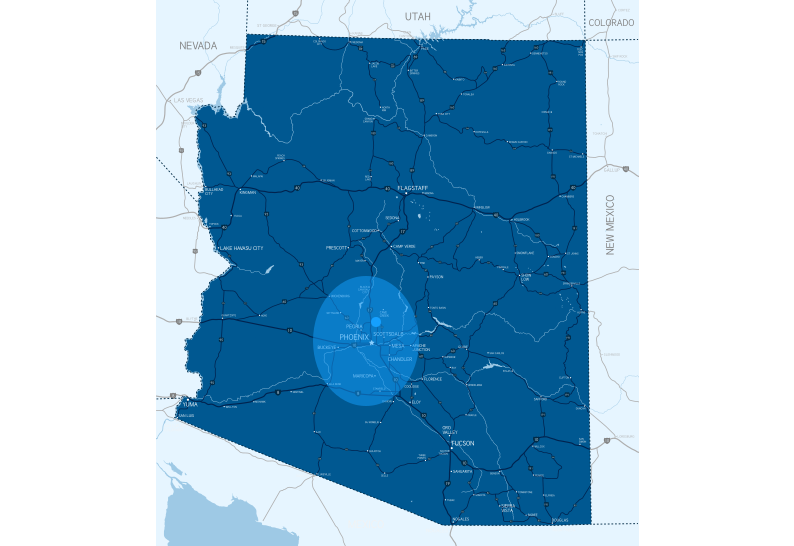
Duct Replacement Across Arizona
Knights of the Attic helps homeowners across Arizona, throughout the Phoenix metro and the surrounding communities below, find out which ducts can be saved, which need to be replaced, and how the system should be laid out to deliver.
- Scottsdale
- Phoenix
- Mesa
- Tempe
- Gilbert
- Peoria
- Chandler
- Apache Junction
- Avondale
- Buckeye
- Carefree
- Casa Grande
- Cave Creek
- El Mirage
- Fountain Hills
- Gila Bend
- Glendale
- Goodyear
- Guadalupe
- Litchfield Park
- Maricopa
- Paradise Valley
- Queen Creek
- Surprise
- Tolleson
- Wickenburg
- Youngtown
Not sure whether we serve your home? Call (602) 675-6827 and we’ll be happy to assist.
Your Next Step
Find Out What Your Ducts Actually Need Before Anyone Replaces Them.
Schedule the free Duct & Attic Assessment. We’ll inspect every accessible run, test the system room by room, show you the evidence, and tell you plainly what should be preserved, what should be replaced, and what can be left alone.
Free assessment · No obligation · Knights of the Attic does not sell or service HVAC equipment. We specialize in the duct and attic delivery system between the equipment and your rooms.